
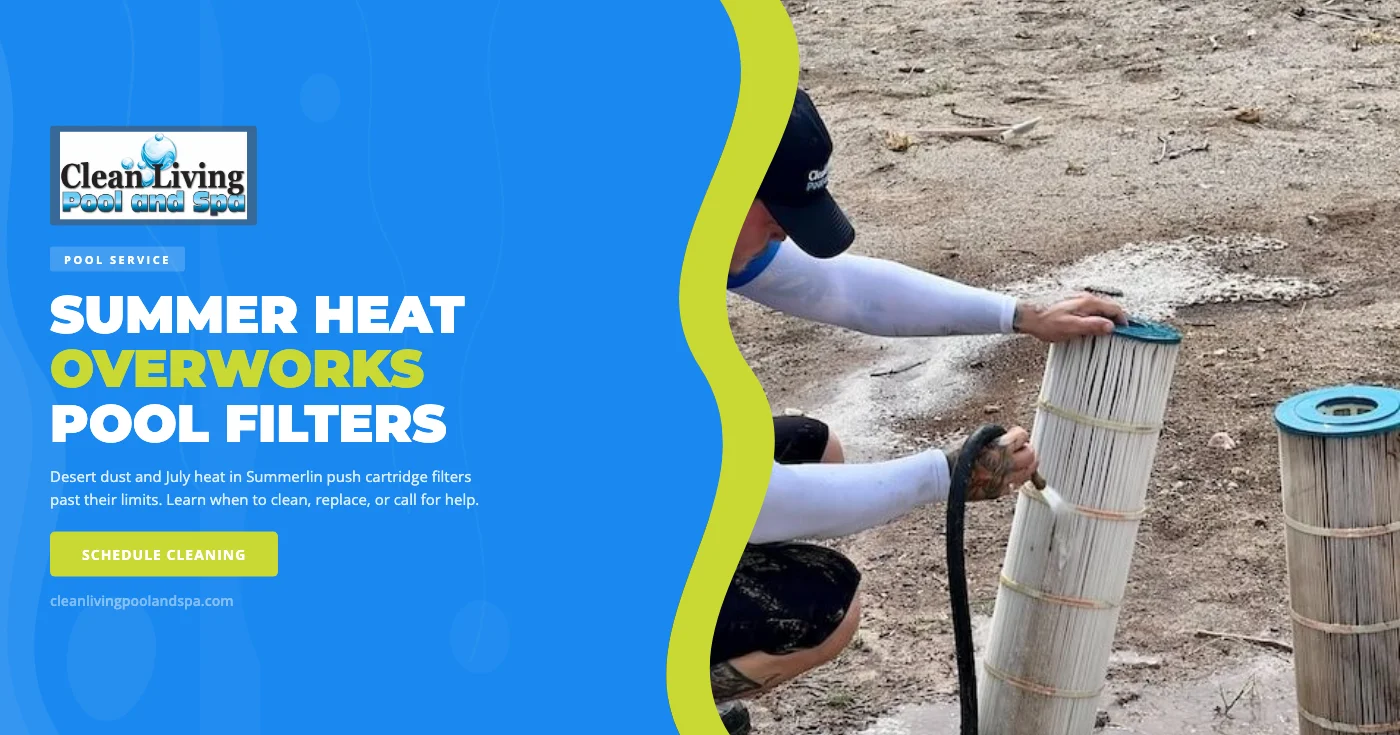
By the middle of July, the Summerlin pools that read a clean 12 psi in June are pushing 20, return jets have gone soft, and the water carries a subtle haze even after a full week of chemistry. Nine times out of ten, the culprit is not chlorine, not the heater, and not an algae bloom. It is the filter — asked to catch three months of desert dust, monsoon particulate, and mineral load in one summer without a real break. At Clean Living Pool and Spa, we run pool filter cleaning summerlin routes from The Ridges through Summerlin South every week of the season, and the pattern is the same across the neighborhood. This guide covers why summer heat and dust storms punish filters here so hard, the warning signs to catch before flow drops, how each filter type handles Vegas conditions, when a cleaning is not enough anymore, and how weekly service keeps the whole system running past Labor Day.
Why Summer Heat and Dust Overwhelm Pool Filters in Summerlin, NV
A Summerlin pool filter runs against three forces at once, and every one of them intensifies from June through September. The first is airborne particulate. Summerlin sits on the western edge of the valley, directly downwind of Red Rock Canyon and the open desert basin, and prevailing winds push a steady load of fine silt across the neighborhood year-round. That baseline load doubles or triples between mid-June and mid-September when monsoon outflows blow through. The National Weather Service notes that monsoon downburst winds regularly reach 50 to 70 mph, occasionally topping 100 mph, and can "reduce visibility to near zero" in seconds (Monsoon Downburst Winds and Dust Storms). One of those events can drop weeks of pleat-loading grit onto every Summerlin pool filter in fifteen minutes.
The second force is water chemistry drift. Summerlin pools evaporate an inch a week or more through July, and every top-off from the tap brings hard, high-alkalinity Colorado River water back in. Calcium hardness climbs, silicates concentrate, and the filter starts catching precipitated minerals on top of the dust. The third force is heat itself. Equipment-pad temperatures push 130°F to 140°F on July afternoons, motors work harder against higher back-pressure, and seasonal fatigue on cartridge pleats and DE grids adds up faster than most owners realize. Filter media rated for a "normal" swim season is running double-duty in ours.
Signs Your Pool Filter Is Struggling This Summer
A struggling filter almost never fails suddenly — it drops signals for two to three weeks before flow collapses. Catching them early is the difference between a routine cleaning and a full remediation.
- Pressure gauge 8 to 10 psi above the clean baseline. Every filter has a starting pressure after a fresh cleaning. Once the gauge sits nearly double-digits above that number, flow through the filter is restricted enough that sanitation, heating, and circulation all begin to suffer.
- Soft return jets. Hold your hand a few feet from a wall return. A healthy Summerlin pool pushes water hard enough to stir the surface several feet out. When the return barely disturbs the water, the filter is choking the pump.
- Hazy water that will not clear. Chlorine can be perfectly balanced and the pool still looks dull. A loaded filter cannot polish out the fine mineral haze and dust that summer air keeps depositing.
- Heater or salt cell low-flow codes. Modern equipment senses flow drops and shuts itself down to protect components. An LF or FLO code mid-summer is almost always a filter complaint, not a heater problem.
- Pump cavitation or new noise. A high-pitched whine, rattling, or intermittent surging is the pump pulling against restricted flow. Left unaddressed, it shortens the life of shaft seals and bearings quickly in 110°F heat.
- Water level dropping toward the mid-skimmer line faster than usual. Evaporation is normal, but a filter that runs less efficiently often runs longer, and the pool loses more water to the extended run time.
Any single signal is a yellow flag. Two or more at once means the filter is past due and the surrounding equipment is starting to pay for it.
Cartridge vs. DE vs. Sand: How Each Filter Handles Vegas Heat
The three common filter types behave very differently in Mojave conditions, and the right choice depends on how the pool is used, how much wind-driven dust it catches, and how much run-time it needs in peak heat.
Cartridge filters are the default new install across most of Summerlin. They filter down to roughly 10 to 20 microns, do not require backwashing (a real advantage under southern Nevada water conservation), and a generously-sized quad-cartridge tank holds enough pleated surface area to absorb normal desert dust loads for six to eight weeks between full cleanings. The catch is that cartridges themselves fatigue faster here. National guidance suggests replacing them every three to five seasons; in our conditions we are usually replacing after two to three. A hose-down is never enough — cartridges need a real chemical soak on a regular cadence.
Diatomaceous earth (DE) filters deliver the finest filtration of any residential system, down to 3 to 5 microns. They earn their place on pools downwind of active construction, along heavily-landscaped Summerlin lots that catch a lot of organic drift, or on pools where the owner wants the clearest water possible. The tradeoff is more upkeep and more backwash water: DE grids need recharging after every backwash, and a full tear-down inspection belongs on the calendar once a year. In peak heat, DE grids that tear or fold quietly bleed powder back into the pool for weeks before an owner notices.
Sand filters filter down to 20 to 40 microns and are the lowest-maintenance of the three, but they are also the least suited to fine windblown silt. A new-media sand bed can pass Summerlin dust straight back into the pool, and sand demands backwash water our region does not have to spare. For most Summerlin homeowners, our default recommendation is a properly-sized quad cartridge on a real cleaning schedule.
When to Clean vs. Replace Your Pool Filter in July Heat
Not every high-pressure reading calls for new media. Most call for a proper cleaning first, and the replacement question comes second.
- Clean first when: pressure is 8 to 10 psi above clean baseline, the media is intact, and the last thorough cleaning was more than four weeks ago. A cartridge chemical soak or a DE backwash-and-recharge usually drops pressure back within 1 to 2 psi of baseline.
- Replace cartridges when: pleats are matted flat, the plastic end caps are cracked or warped, the media has visible burn-through or a brown scale that will not release after a soak, or the filter is on its third or fourth summer in Vegas. Two full seasons is often the realistic lifespan here.
- Replace DE grids when: the pool sees DE powder in the return jets after a recharge, backwash pressure does not drop after cleaning, or the annual tear-down reveals torn fabric or a broken manifold.
- Replace sand media when: the bed is 5 to 7 years old, or short-circuiting is dropping fine particulate through. Sand is a longer-cycle replacement, but it is not permanent.
In July specifically, replacement decisions get pushed forward. A cartridge that would have limped through spring for another month may need to come out now, because the ambient heat and dust load do not give the filter any recovery windows.
Professional Pool Filter Cleaning in Summerlin: What to Expect
A real filter cleaning is not a fifteen-minute hose job — it is a full disassembly, media evaluation, chemical treatment, and reinstall with baseline documentation. On a professional Summerlin filter service visit, our routine covers the entire system.
The tank is depressurized and opened. Cartridges are pulled and inspected pleat by pleat for burn-through, mineral scale, and structural fatigue. For DE, the grids come out of the manifold for a full visual on the fabric. Elements then get a chemical soak — a purpose-formulated cleaner for mineral scale, a separate treatment for oils and sunscreen — long enough to release what a hose-down cannot. After the soak, elements are rinsed at low pressure to avoid tearing pleats. The tank interior is cleaned, the O-ring is inspected and lubricated, and gaskets are replaced when they show heat damage. On reinstall, the pump is primed, the filter is bled of air, and the new clean pressure is recorded on the equipment card. That baseline is what every future service call gets measured against. Skipping any step is how filters get "cleaned" three times a summer and still lose flow.
How Weekly Pool Service Extends Your Filter's Life
The single strongest predictor of filter lifespan in Summerlin is not the media brand — it is whether the pool is on a real weekly service route. Filters on maintained pools last two to three seasons; filters on inconsistently-serviced pools last one, sometimes less. The reason is that a weekly visit catches the small problems before they cascade into filter overload.
On our weekly pool service stops, the routine visit includes a pressure reading logged against the clean baseline, a return-jet feel check, a phosphate quick-test after any dust event, skimmer and pump basket emptying, a full brush of walls and steps to lift fine silt off surfaces so the filter can capture it in suspension, and a chemistry look to keep calcium hardness from drifting into scale territory. When pressure climbs faster than expected between visits, the filter gets a mid-cycle cleaning before it starts choking the rest of the system. Weekly service is the single most cost-effective way to protect the filter, pump, and heater from the compounding damage a Mojave summer inflicts on everything downstream of the skimmer. Our team has serviced Summerlin pools since 2012, and every route we run is built around the same rhythm: catch the small problem in week one so it does not become a full remediation by week three. If your filter pressure is climbing this summer, or the water is not clearing the way it did in June, get in touch — we will pull the filter, inspect the media, and get you a clear baseline for the rest of the season.
Frequently Asked Questions
How often should I clean my pool filter in Summerlin's summer heat? For a cartridge filter in July and August, plan on a full chemical soak every six to eight weeks — sometimes sooner if the pressure gauge climbs faster than expected after a windy week or a monsoon dust event. Sand filters need a backwash every three to four weeks in summer, and DE filters need a recharge every four to six weeks. The pressure gauge is always the final word; a reading 8 to 10 psi above the clean baseline is the trigger regardless of the calendar.
Does a dust storm really overwhelm my pool filter that fast? Yes — a single monsoon outflow can drop weeks of fine particulate into a pool in a fifteen-minute wall of dust. That grit goes straight through the skimmer and lodges in cartridge pleats or across the DE grids. After any major dust event, a good habit is skimming and brushing within twelve hours, testing chemistry within twenty-four hours, and checking filter pressure the next day. Vacuuming heavy debris to waste (if you have a multiport valve) instead of pushing it through the filter can also save weeks of filter life.
Should I upgrade from cartridge to DE for cleaner Summerlin water? For most Summerlin residential pools, a properly-sized quad cartridge on a real cleaning cadence delivers plenty of clarity without the added maintenance and backwash water DE demands. DE upgrades pay off on pools downwind of construction, on heavily-landscaped lots that catch a lot of organic drift, or when the owner specifically wants the finest possible filtration. We are glad to walk your equipment pad and recommend the best fit for your pool, your water use, and your neighborhood conditions.