
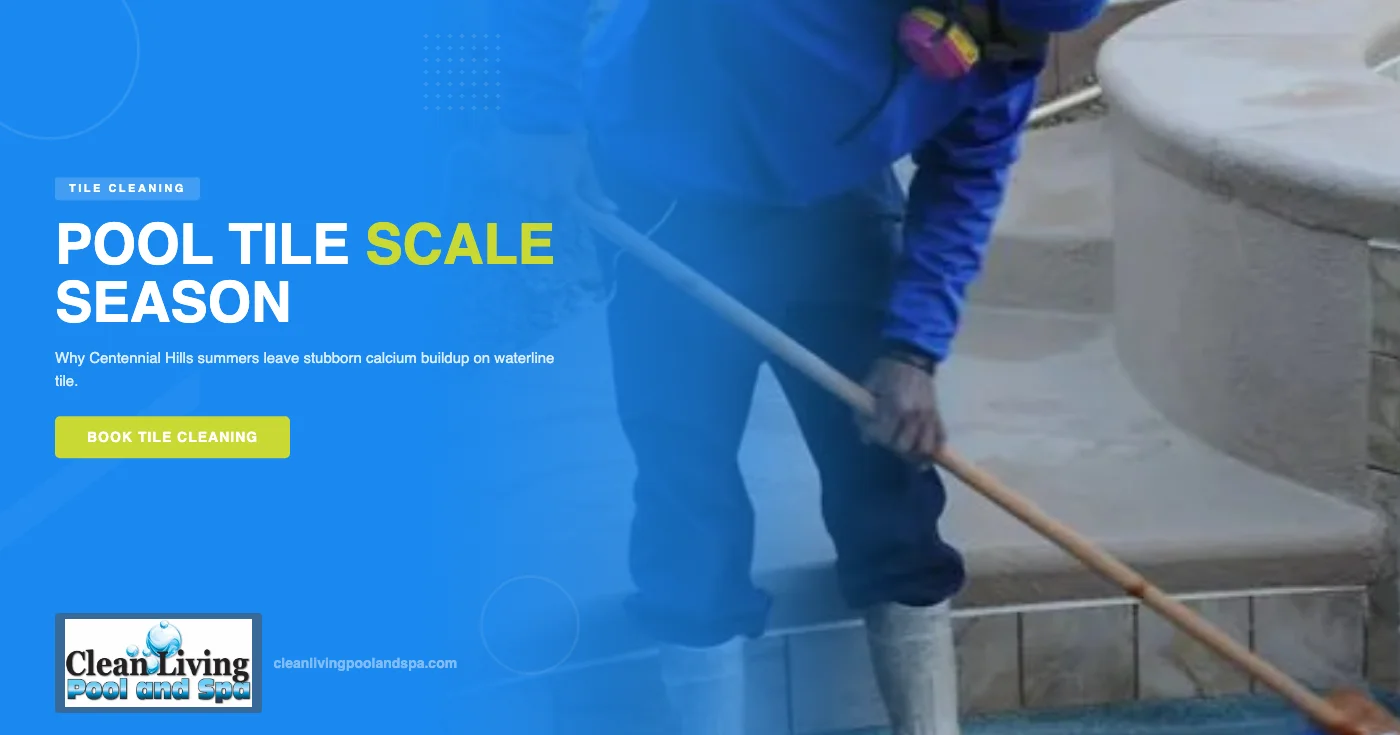
Every Centennial Hills summer ends the same way at the waterline. Tile that read clean and glossy in April has a chalky white belt across the top row by mid-August, and by Labor Day that band has thickened, hardened, and started climbing the second course. The water source is the reason. Las Vegas draws almost all its municipal supply from Lake Mead, and Colorado River water carries approximately 318 mg/L of calcium carbonate — one of the highest hardness levels of any major U.S. city (Las Vegas' water is "very hard"). Combine that mineral load with 110°F afternoons, evaporation that pulls nearly an inch of water off a pool every week, and pH that drifts up in the heat, and pool tile cleaning centennial hills calls climb every July for the same reason. At Clean Living Pool and Spa we run Pool Maintenance Services throughout Centennial Hills, and this guide covers why scale sets in so fast here, why DIY approaches usually fall short, what professional bead blasting looks like, and what to do between visits to slow the buildup.
Why Centennial Hills Pool Tile Scales Up So Fast in Summer
Centennial Hills sits on the northwest edge of the valley, at elevation, exposed to open desert on two sides. That geography sets three of the fastest scale-building conditions in the region into motion at the same time. Municipal water is very hard year-round — the Colorado River drops 1,400 miles through calcareous terrain before reaching southern Nevada and picks up extraordinary levels of dissolved calcium, magnesium, and sulfates along the way. Summer evaporation is extreme, and every top-off adds fresh mineral-heavy water back. And afternoon deck temperatures push 130°F, warming the pool and shifting the chemistry toward precipitation.
All three pressures push calcium out of solution and onto the nearest solid surface. The waterline tile is exactly where the film sits longest between splash events, so that is where scale builds first and fastest. What in a milder climate would be occasional maintenance is, in Centennial Hills, a summer-long compounding problem.
Calcium Scale vs. Waterline Stains: What's Really on Your Tile
Not everything on the waterline is scale, and mistaking one type of buildup for another is the most common reason DIY cleaning attempts leave a pool looking worse than before. The three categories that actually matter behave completely differently.
Calcium carbonate scale is the softer, white, chalky variant. It forms early — often within the first several months — when pool pH climbs above 7.8 and calcium precipitates onto the tile. A drop of mild acid on carbonate scale fizzes visibly. Most Centennial Hills pools develop it by late summer, and if it is caught early it responds to gentle chemical treatment and light mechanical work.
Calcium silicate scale is the harder, grayer variant that forms when carbonate has been left a year or more to bond with silicates in the water. It does not fizz when acid is applied. Silicate has fused into the tile surface, and no scrubbing or consumer product will lift it without dulling the tile. Bead blasting is the standard professional method for silicate removal.
Waterline residue is the thin grayish or brown film of sunscreen, body oil, and airborne dust that sits on top of the tile. It brushes off with routine care and is not scale at all, though it can hide early scale beneath it if left untouched for weeks.
The right approach depends entirely on which of these is on your tile. Guessing wrong wastes time and often damages the surface.
How Desert Heat and Evaporation Speed Up Hard-Water Buildup
Water hardness alone would deposit scale eventually anywhere. Centennial Hills conditions turn "eventually" into "by August." Three physical factors compound the mineral load and force scale to form faster than pool chemistry alone would predict.
The first is evaporation rate. When water leaves the pool as vapor, minerals stay behind. A Centennial Hills pool losing 0.75 inches a day through July concentrates its calcium hardness 3 to 4 percent per week, and every top-off adds fresh 318 mg/L Colorado River water on top. Left unchecked, calcium hardness can climb from 300 ppm in June to past 500 ppm by Labor Day.
The second is temperature. Warm water holds less dissolved calcium — when a pool sits at 88°F to 92°F for weeks, the solubility limit drops and precipitated calcium looks for the nearest surface. The waterline tile, hot under direct sun, is the first place that happens. The third is pH drift. Between chlorine tabs pulling pH down and outdoor CO₂ loss pushing it up, Centennial Hills pool pH swings high in the heat. Even a brief stretch above 7.8 accelerates carbonate precipitation, and a visible chalky ring can appear within weeks in a pool that had none.
Why DIY Scrubbing Falls Short (and Can Damage Your Tile)
Home improvement stores stock pumice stones, acid-based scale removers, and muriatic acid kits marketed for pool tile cleaning. Each of these has a narrow, appropriate use — and a much wider set of situations where they leave the tile in worse shape than they found it.
Pumice stones abrade soft carbonate scale off tile through friction. On ceramic body tile with a durable glaze, careful use on light buildup can work. On glass tile, hand-painted tile, polished tile, or any decorative finish, pumice will scratch, dull, or chip the surface — and once the glaze is etched it cannot be restored short of replacement.
Consumer scale removers are formulated at concentrations low enough for retail. On light carbonate they can help, but on the hardened scale most Centennial Hills pools carry by late summer, they produce partial results that require repeat applications. Every repeat exposes tile and grout to more acid than a single professional treatment would.
Muriatic acid dissolves calcium carbonate quickly but is difficult to handle at home. It splashes, it fumes, and if it enters the pool water uncontrolled it can drop pH sharply enough to etch plaster and corrode metal fittings. Spot-treating tile without proper containment, ventilation, and rinsing almost always damages either the tile, the surrounding surfaces, or the pool chemistry.
DIY methods also cannot touch silicate scale at all. Any pool that has gone a year or two without professional attention likely has silicate buildup that no home method will lift, and continued scrubbing only wears down the tile beneath.
How Professional Tile Cleaning and Bead Blasting Work
A professional tile cleaning is a diagnostic first and a matched treatment second. Our routine starts with a small acid test that tells us whether we are dealing with carbonate, silicate, or a mixed deposit. From there the treatment splits into two paths.
For carbonate scale caught early, we apply a professional-grade scale remover with dwell time matched to the buildup depth, then finish with a mechanical assist using media appropriate for the tile. Chemistry is rebalanced immediately after so the fresh tile is not sitting against water that will re-deposit scale within days.
For hardened carbonate and any silicate deposit, we move to bead blasting: a low-pressure abrasive process that uses glass beads, sodium bicarbonate, or magnesium sulfate media — chosen for the tile material — to abrade the scale off without damaging the glaze underneath (Kramer Industries: Pool Tile Cleaning & Blasting). Pool water is lowered slightly below the tile band, and the technician works the perimeter section by section as the media exposes the original tile surface. Glass beads are standard for ceramic and porcelain; sodium bicarbonate is the gentler option for glass tile and hand-painted finishes. A typical residential Centennial Hills pool takes three to five hours.
The final step in either path is a chemistry reset. Calcium hardness, pH, and total alkalinity get pulled back into range before the pool returns to normal circulation. Cleaning the tile without correcting the water that caused the buildup is a two-week fix at best.
How Often Centennial Hills Pools Need a Tile Cleaning
Cadence depends on chemistry management, splash exposure, and how fast calcium hardness is climbing. A few honest baselines for Centennial Hills:
- Once a year — minimum. Every pool in the valley benefits from a professional tile cleaning at least annually. The combination of hard water, heat, and evaporation makes some level of buildup inevitable.
- Every 8 to 10 months for pools with heavy splash zones — waterfalls, deck jets, bubblers, spa spillovers — where the mineral-rich film sits against the tile more often.
- Every 6 to 8 months for pools where calcium hardness has climbed above 500 ppm, or where the tile is already showing visible buildup.
- Every 12 to 18 months for pools on a professionally managed weekly service with tight chemistry all year.
The trigger to book earlier than the calendar suggests is visible scale. Once a chalky band shows from the pool deck, the buildup is already thick enough that removal takes longer, costs more, and is harder on the tile than if it had been caught in the light-film stage.
Keeping Your Waterline Clear Between Professional Cleanings
A professional cleaning removes what has built up. What determines how quickly the next band forms is what happens on the pool deck between visits. A few habits meaningfully extend the interval.
- Hold pH between 7.4 and 7.6. The single strongest lever a pool owner has against scale. Test twice a week through summer and adjust the moment the reading drifts above 7.6.
- Watch calcium hardness. Once the reading climbs above 500 ppm, no pH management will fully suppress scale formation. A partial drain-and-refill or a reverse osmosis treatment resets the baseline.
- Brush the waterline weekly. A few passes with a tile brush lift early-stage carbonate film before it hardens into bonded scale.
- Use a scale inhibitor. Phosphate-based and polymer-based inhibitors bind calcium and magnesium in solution and slow deposit rates. In a market this hard, an inhibitor is standard equipment.
- Keep water level consistent. A pool that swings up and down over a wide band widens the wet-dry cycling zone and accelerates scale formation above the normal waterline.
Our weekly service visits in Centennial Hills include a waterline brush, chemistry rebalance, filter pressure check, and a visual pass on tile and equipment for early buildup. That consistent attention keeps annual tile cleanings from turning into full-season restoration projects. At Clean Living Pool and Spa we have serviced Centennial Hills pools since 2012, and the pattern is clear — the tiles that come through summer clearest are on a real cleaning cadence with a scale-aware weekly routine. If your tile is showing a chalky band this month, reach out and we will assess the buildup, identify the scale type, and set a cleaning plan matched to the tile.
Frequently Asked Questions
How often should I have my pool tile professionally cleaned in Centennial Hills? Once a year at minimum, every 8 to 10 months if your pool has heavy splash zones or already shows visible scale, and every 6 to 8 months when calcium hardness has climbed above 500 ppm. The trigger to book earlier is a chalky band visible from the deck — by that point removal takes longer and is harder on the tile.
Can I remove calcium scale from my pool tile myself? Light, early-stage carbonate scale on durable ceramic tile can respond to a pumice stone used carefully. Hardened carbonate, any silicate deposit, and any decorative or glass tile is a professional-only situation. Pumice will scratch glazed and glass tile, muriatic acid can drop pool pH sharply enough to etch plaster, and consumer scale removers are not concentrated enough for the buildup most Centennial Hills pools carry by late summer.
What is bead blasting and is it hard on my tile? Bead blasting uses fine glass, sodium bicarbonate, or magnesium sulfate media at low pressure to lift calcium scale off tile without damaging the glaze underneath. Media is matched to the tile — glass beads for ceramic and porcelain, sodium bicarbonate for glass and hand-painted finishes — and the technician works section by section around the perimeter. A residential Centennial Hills pool typically takes three to five hours.