
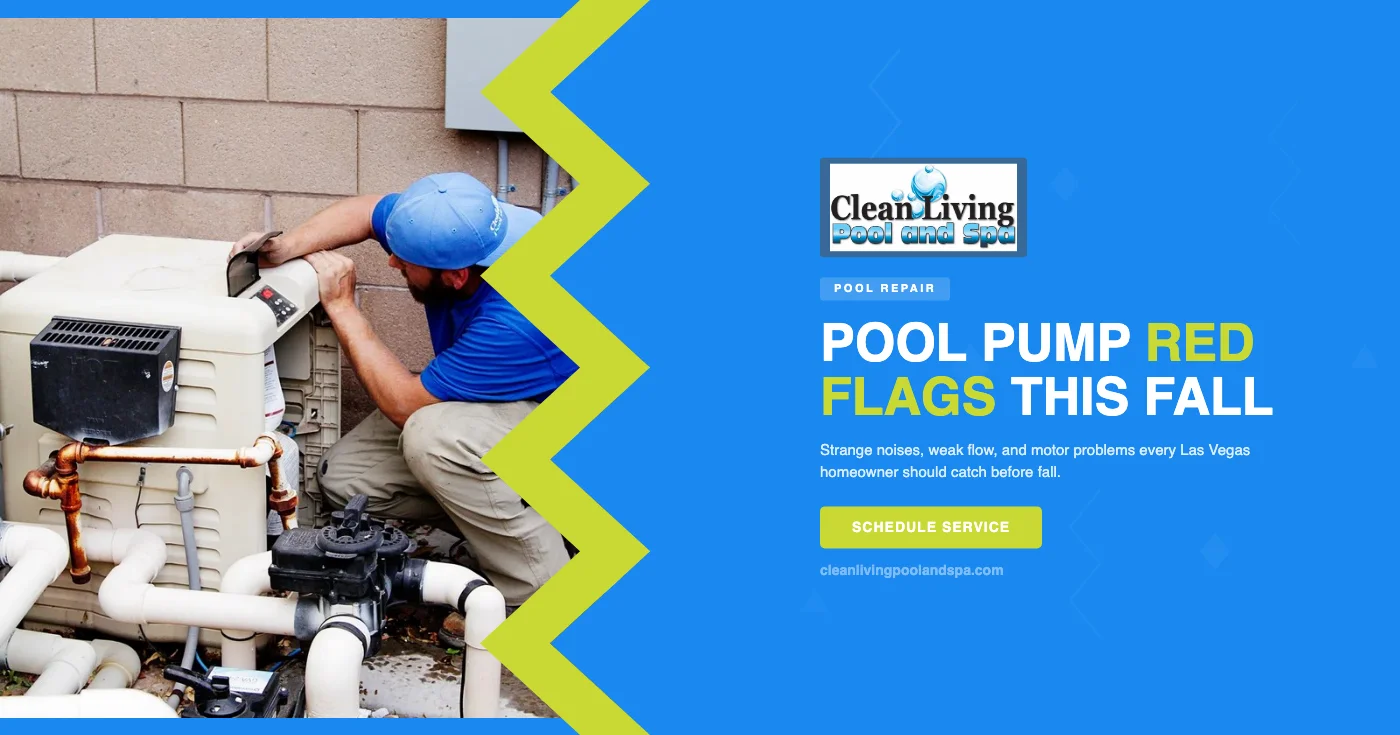
The most expensive pool pump failure of the year is the one that shows up in early April, when the water finally warms up and the pump refuses to prime. Nine times out of ten, that failure sent signals in September — a new noise, a filter 8 psi over baseline, a chlorine residual that stopped holding overnight — and nobody was listening. Fall is when a full Las Vegas summer's worth of wear surfaces on cooling equipment, and it's the highest-value window of the year for pool pump repair las vegas homeowners can act on before winter forces a decision. At Clean Living Pool and Spa, we run Pool Repair Services across Las Vegas, North Las Vegas, Summerlin, and Centennial Hills. This guide covers the pump, motor, and circulation red flags we see every September, when to repair versus replace, and how to get the most life out of the equipment you already own.
Why Fall Is the Right Time to Inspect Your Las Vegas Pool Equipment
By mid-September in the Las Vegas valley, daytime highs still push 98°F to 105°F while pre-dawn lows drop into the upper 60s. That 30-degree daily swing works pump housings, filter tank clamps, cartridge end caps, and heater exchanger metal every 24 hours — and equipment that survived June through August because it stayed heat-soaked constantly starts to fatigue as it expands and contracts through a wider range. The pump is still running summer hours at summer load, but swimmer demand is dropping, so problems that hid behind heavy circulation quietly rise to the surface. Chlorine that burned off in six hours in July begins holding overnight as UV weakens, pH creeps upward as CO2 gasses out of cooler water, and cyanuric acid pushed past 90 ppm with three months of tabs now suppresses sanitizer efficacy — all of that puts extra load on the pump, filter, and heater at the exact moment they're showing four months of wear.
The reason we push a fall inspection so hard is economics. A $180 to $250 pool equipment repair las vegas call in September catches a shaft seal weep before the motor windings short, an exchanger scale layer before the heater cracks, and a saturated filter before it starves the pump through winter. The same problem discovered when the pool won't start in April routinely doubles or triples in price.
Warning Signs Your Pool Pump May Be Failing
Pool pumps rarely fail without warning. The signals show up two to four weeks before something breaks, and reading them early is the difference between a service call and a full replacement. Through late September and October, watch for any of the following:
- Filter pressure 8 to 10 psi above the clean baseline. Both Pentair and Hayward tie the deep-cleaning trigger to that range (Cleaning and Maintaining Your Pool Filters, Pentair). Above baseline, sanitation, heating, and circulation all suffer at once.
- A new noise on the pad. Whining, rattling, intermittent surging, or a rhythmic clunk is the pump pulling against restriction or a shaft seal letting air into the volute. On a September afternoon still delivering 105°F pad temperatures, that stress compounds fast.
- Chlorine that will not hold overnight. As UV weakens, a healthy pool should stretch its residual — not lose it faster. An overnight drop past 1.5 ppm points at high organic load, cyanuric drift, or a filter cycling debris back into the water.
- Heater or salt cell low-flow codes. An LF, FLO, or LO code in September is almost always a filter, valve, or pump-flow complaint — not a heater problem. Ignoring it risks a cracked exchanger by December.
- Longer pump runtime for the same clarity. If the timer is up two or three extra hours a day just to hold water quality, something upstream is choking flow.
- The pump is painfully hot to the touch. Five seconds of comfortable contact on the housing is roughly the ceiling. A pump too hot to hold is burning energy as heat instead of moving water — and every hour it runs that way, the windings degrade.
Two or more of these together mean the diagnostic visit shouldn't wait past next week. A las vegas pool repair service catching those signals in September almost always writes a shorter, cheaper work order than the same crew called out in an emergency in April.
Motor Problems to Watch For Before the Season Ends
Motor failure is the most common reason a pump ends up on a service ticket, and September is when four months of Mojave summer catch up to it. Pool pump motors are air-cooled — the fan on the back pulls ambient air across the windings to keep them in their rated range — and once a motor regularly runs near the top of its temperature rating, degradation accelerates on its own. Industry guidance on residential pool pump service life sits at 8 to 12 years, and the valley climate tends to push units toward the low end of that range unless the pump was properly sized and shaded. The four motor complaints we open most often on pool motor repair las vegas nv calls this time of year:
- Run capacitor degradation. The capacitor keeps the windings in phase under load, and desert heat quietly kills it. A humming motor that won't spin up, a slow start that eventually reaches speed, or a breaker that trips on startup all point here. Caught early, it's a routine swap; left alone until it takes the windings with it, it's a full motor replacement.
- Thermal overload cycling. Motor runs 20 to 45 minutes, thermal switch trips, restarts 30 minutes later. Repeated cycling in September usually points at a degrading capacitor, a fan shroud packed with monsoon dust, or an impeller starved for flow.
- Bearing wear. Grinding, screeching, or rhythmic clicking is the bearing on the way out. Once it fully fails, the shaft wobbles, the mechanical seal typically goes with it, and water reaches the windings within days. Caught early, it's a bearing kit; caught late, it's a new motor.
- Mechanical seal weep. Water dripping under the pump housing where the shaft enters the wet end is a seal failure in progress. A seal swap on a healthy pump is straightforward; a pump that's been dripping onto motor terminals for a month is usually beyond repair.
Any two of these in the same week almost always means the motor is close to a decision point — and September is when acting on it costs the least.
What Weak Water Circulation Really Tells You
When homeowners describe a pool that "just doesn't seem to be turning over," the pump gets blamed first — but weak circulation is a whole-system signal, and the root cause is usually two or three components downstream. A slow return jet, a skimmer that barely pulls, or a bottom drain with no visible flow each point somewhere specific. The most common cause is a saturated filter — a cartridge carrying a summer of scale, body oil, and monsoon dust can drop system flow by 30% to 50% before the pressure gauge reads dramatically high, because the restriction is uniform across the pleats. Second-most-common is a valve issue: a multiport gasket letting water bypass the filter, or an actuator not rotating fully through its arc.
Air intrusion is the third culprit — a dried-out pump lid o-ring, a weeping suction-side union, or a stuck skimmer weir at low water can pull air into the volute and drop prime intermittently. The pump surges, return jets spit air, the pressure gauge oscillates. The CDC recommends operating filtration and recirculation systems on the manufacturer's schedule and adjusting based on load (Operating and Managing Public Pools, CDC) — in the Las Vegas valley, weak flow is the earliest signal the system can't meet its schedule anymore.
When to Repair vs. Replace Pool Equipment in Las Vegas
The repair-versus-replace conversation gets easier once you know the age of the unit and the failure mode. On pumps, we lean toward repair when the motor is under seven years old, the failure is a discrete component (capacitor, seal, bearing kit), and the wet end and housing are intact. We lean toward pool pump replacement las vegas when the motor is past ten years, the windings have burned, the housing has cracked, or the same motor has taken two or more component repairs in the previous twelve months.
On filters, cartridge units get repaired at the pleat level until the tank itself is compromised. DE filters get repaired at the grid and manifold level unless the tank is rusted through. Sand filters older than fifteen years and losing pressure retention almost always go faster on a replacement than a rebuild. Heaters are the one place we tell homeowners to be careful with repair spend — a cracked exchanger, a rusted burner tray, or an ignition assembly that's failed twice inside a season usually means the parts investment approaches the cost of a new unit, and modern high-efficiency heaters run at 84% to 96% versus 70% to 78% on older cast-copper models.
The framework we walk homeowners through: total repair cost approaching 50% of a new unit, or a third significant failure within eighteen months, or a component the manufacturer no longer produces — any of those tips the calculus toward replacement. Equipment showing repeated failures in a short interval usually signals a systemic issue (hydraulic sizing, chemistry, or electrical supply), and that pattern points at unit replacement rather than continued part-level repair.
How to Extend the Life of Your Pool System
The single highest-return maintenance habit for Las Vegas pool owners is keeping the equipment pad shaded and ventilated. A pump running at 105°F ambient instead of 130°F ambient can add three to five years of motor life — the physics of insulation breakdown are that direct. A shade structure, a repositioned enclosure, or a well-placed shrub can drop pad temperatures 15°F to 25°F and pay for itself in extended pump life within two summers.
The second habit is filter discipline: clean on the pressure trigger (8 to 10 psi over baseline), not the calendar, and deep-clean cartridges in a filter solution once a year. The third is chemistry that stays in range — calcium hardness above 500 ppm, pH above 7.8, and cyanuric past 90 ppm each shorten the life of every metal and plastic component the water touches. A weekly test cadence — the same discipline built into our Weekly Pool Service — catches drift early. The fourth is runtime matched to the season: ten to twelve hours in July, eight to ten in September, six to eight in November. Summer hours through fall wastes electricity and puts unnecessary hours on the motor.
Calling a Professional: What to Expect from Pool Repair Services
When we come out on a pool equipment call, we plan on 45 to 90 minutes on-site — enough time to see the whole system, not just chase the symptom that triggered the call. The visit starts with a short conversation about what you've noticed: the noise, the pressure, the chemistry drift, the runtime that keeps climbing. From there we walk the pad together. The pump gets a full inspection — housing, volute, impeller, shaft seal, motor terminals, capacitor, fan shroud. The filter comes apart for a direct visual on the media. The heater walks through with a burner and exchanger check plus a low-flow interlock verification. Valves and actuators get cycled, and chemistry runs through a full panel on-site.
You leave with a written work order — the immediate repair, a parts list with pricing, and a prioritized list of what can wait through winter and what belongs on a spring watch list. Nothing on it is a sales pitch; it's what a technician who's been through hundreds of Las Vegas summer-to-fall transitions is telling you the pool needs. Clean Living Pool and Spa has been running pool equipment repair and consultation across Las Vegas, North Las Vegas, Summerlin, and Centennial Hills since 2012, and every visit ends with a clean baseline you can measure future changes against.
Frequently Asked Questions
How long should a pool pump last in Las Vegas? Industry guidance runs 8 to 12 years for a well-maintained residential pump. Valley units tend to come up on the low end because of pad heat load — a shaded pump with regular filter cleanings routinely reaches 10 to 14 years, while an unshaded south-facing pad in full sun often replaces at 6 to 8. Variable-speed pumps generally outlast single-speed because they run cooler at lower RPM.
Is it worth repairing an older pool pump or should I replace it? Under seven years old with a discrete component failure (capacitor, seal, bearing kit) — repair almost always wins. Past ten years, two or more repairs in the last year, or cracked plastic on the wet end or housing — replacement usually pencils out, especially when the new unit is variable-speed and starts recovering its cost immediately in lower electricity bills.
What is the most common reason a pool pump fails in the fall? A degraded run capacitor. Desert heat is hard on capacitors, and by September the summer has usually pushed a marginal unit over the edge. Symptoms — humming without spin-up, slow starts, breakers tripping — are subtle enough that most homeowners live with them for a couple of weeks before calling. Catching the capacitor before it takes the windings with it is the single most common repair we do this time of year.