
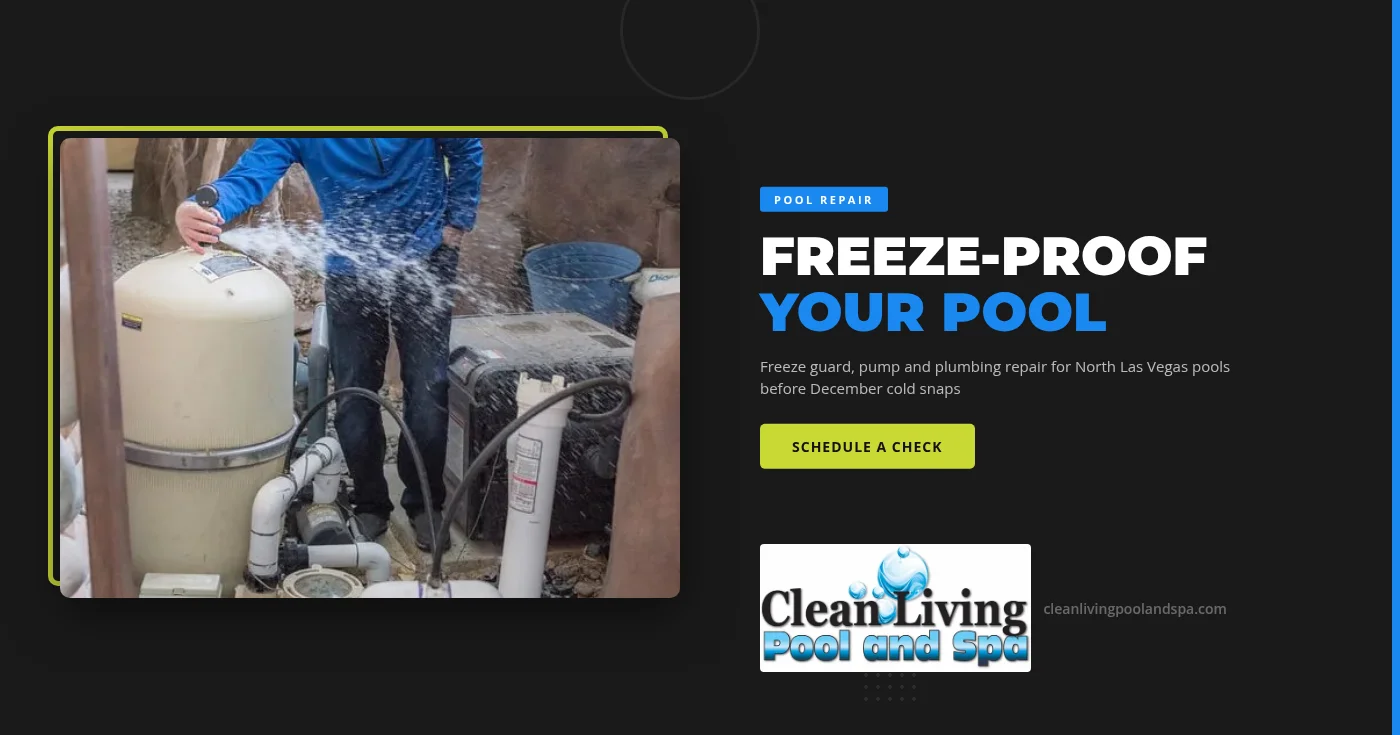
Most homeowners in North Las Vegas don’t think of their pool as something that can freeze. Then a clear, still December night slips below 32°F, the pump sits idle because a sensor quietly failed weeks ago, and by morning a split PVC fitting is spraying water across the equipment pad. Pool freeze protection repair is what keeps that morning from happening, and November is the best time to get it done.
Here at Clean Living, we’ve looked after pools across the valley since 2012, and we see the same pattern every winter. The freeze guard looks fine on paper, but one link in the chain isn’t ready for the cold. That link might be the air sensor, the pump, the motor or a tired valve.
Below, we’ll cover why freeze risk is real here, how freeze protection works, the warning signs of trouble, the pump, motor and plumbing problems we find most often, what a pre-winter check includes, and what to do if your equipment freezes anyway.
Why North Las Vegas Pools Still Face Freeze Risk on Clear December Nights
Desert winters are mild by most standards, which is exactly why freeze damage catches people off guard. December afternoons can feel pleasant, but dry air and cloudless skies let the day’s heat radiate away quickly after sunset. On calm, clear nights, temperatures can drop sharply in a few hours, and the coldest stretch usually lands just before dawn, when nobody is outside to notice.
The National Weather Service office in Las Vegas tracks local freeze warnings and climate records, and most winters bring at least a handful of nights at or below freezing, typically in December and January. The northern parts of the valley often run a few degrees colder than the official airport reading, so the number on the evening news may not match what your backyard actually sees.
Your equipment pad matters too. Many pads sit on the north side of the house or in a shaded side yard, where they get little winter sun. That puts the most vulnerable parts of your pool in the coldest spot on the property.
Then there’s the sun damage that builds up all summer. UV exposure makes above-ground PVC, valve bodies and sensor wiring brittle over time. Water expands roughly 9% as it freezes, and brittle pipe has far less give when that happens.
How Pool Freeze Protection Works: Freeze Guards, Air Sensors and Automation Settings
The idea is simple: when the air gets cold enough, your system runs the pump so water keeps moving instead of sitting still and freezing in the pipes. In practice, it depends on three things working together.
The Air Sensor
Most automation systems use an outdoor air temperature sensor, usually a small thermistor mounted near the equipment pad. When it reads a set low temperature, the controller switches into freeze mode. If the sensor sits in direct sun, has cracked wiring or has drifted out of spec, it can read several degrees warm, and freeze mode never kicks in.
The Automation Settings
Many systems trigger freeze mode somewhere around 36–38°F, though the exact default varies by brand and model. Manufacturer documentation, such as the manuals in Pentair’s support library, lists each controller’s settings and the sensor resistance chart technicians use for testing. Freeze protection also has to be enabled on every circuit that needs it, and settings can get wiped after a power outage or controller update.
Variable-Speed Pump Freeze Speed
Variable-speed pumps are efficient, but the freeze speed has to be high enough to push water through every line, including solar returns, cleaner lines and spa plumbing. A speed that barely turns over the main loop can leave a side line sitting stagnant on the coldest night of the year.
Warning Signs Your Freeze Protection System Needs Repair
Freeze protection problems rarely announce themselves. A system can look normal all fall and only reveal a fault on the first cold night. These are the signs we ask homeowners to watch for:
- An odd air temperature on the controller. If the display reads 70°F on a chilly morning, or swings wildly, the sensor or its wiring is likely at fault.
- A silent pump on cold nights. If the equipment is quiet on a near-freezing evening, freeze mode may be disabled or not triggering.
- A pump that runs nonstop on warm days. A sensor reading too cold can lock the system into freeze mode and drive up your power bill.
- Error codes or tripped breakers. Repeated trips point to an electrical fault that could leave the pool unprotected when it matters most.
- Unusual pump noise. Grinding, humming or screeching often means worn bearings or a failing capacitor.
- Cracked or chalky PVC and weeping valves. These are the first places freeze damage tends to show up.
If you notice any of these, pool freeze guard repair is usually a quick job in November and a much bigger one in January, after something has already split.
Pump and Motor Problems That Leave Pools Unprotected in Cold Weather
Here’s the part many people miss: freeze protection only works if the pump works. The smartest controller available can’t move water through a pump with a seized motor.
Capacitors, Bearings and Breakers
A failing start capacitor is one of the most common reasons a pump hums but won’t spin. Worn motor bearings get louder over time and can lock up entirely, especially after a long summer of heavy run times. A tripped breaker or GFCI shuts everything down without warning, and if it trips on a freezing night, the pool has no protection until someone resets it. Many of the calls we get for pool pump repair in North Las Vegas trace back to one of these three problems.
Signs a Motor Won’t Make It Through Winter
Watch for a motor that runs hot to the touch, trips its thermal overload, struggles to prime or makes a steady grinding noise. Rust streaks on the housing and water dripping from the shaft seal are red flags too, since a leaking seal can let water into the bearings.
When Pool Motor Replacement Makes Sense
Sometimes a new capacitor or seal is all it takes. Other times, an aging motor has reached the end of its life, and pool motor replacement is more dependable than repeated patch repairs. We walk you through both options so you can choose what fits your pool.
Exposed Plumbing, Valves and Fittings: Common Freeze Damage Points and Fixes
Pool plumbing freeze damage almost always starts above ground. Water trapped in still pipe has nowhere to go as it expands, so the weakest point gives way. On a typical equipment pad, the most at-risk spots are:
- Above-ground PVC runs, especially sun-bleached sections
- Valve bodies and diverter valves, which hold water in tight chambers
- The pump wet end, including the strainer housing and lid
- Filter drain caps and pressure gauge ports
- Heater headers and inlet and outlet fittings
- Solar return lines on the roof, which drain slowly and sit fully exposed
The fixes are usually straightforward when caught early. We replace brittle or cracked PVC and fittings, rebuild or replace leaking valves, swap worn O-rings and drain caps, and add foam pipe insulation to exposed runs. For pools with solar heating, we confirm the solar lines either drain properly or get enough flow during freeze mode.
A small drip at a valve stem in November can become a split valve body after the first hard freeze. That’s why pool equipment winter repair is far easier to handle before the cold arrives than after it.
What a Professional Pre-Winter Freeze Protection Check Includes
Here at Clean Living, our pre-winter check is built to test every link in the chain, not just glance at the controller. A typical visit includes:
- Testing the air sensor with a multimeter against the manufacturer’s resistance chart and checking where it’s mounted
- Confirming freeze protection is enabled on every circuit that needs it
- Setting or verifying the freeze speed on variable-speed pumps
- Inspecting the pump for capacitor, bearing, seal and priming issues
- Checking breakers, GFCIs and wiring at the equipment pad
- Looking over PVC, valves, fittings, drain caps and heater connections for cracks or leaks
- Recommending insulation for exposed runs and any repairs worth doing before December
Because we’re already at many pools every week through our pool maintenance and pool cleaning routes, we often spot early trouble, like a noisy motor, a damp valve or a sensor reading that doesn’t add up, before it becomes a freeze-night emergency. November is also a calmer month on our schedule, which makes it easier to fit repairs in before the holidays and gives you real peace of mind going into winter.
What to Do If Your Pool Equipment Freezes or Fails During a Cold Snap
Even with good preparation, equipment can fail during a hard freeze. If you wake up to a silent pump on a frosty morning, here’s what we recommend:
- Don’t force a frozen pump to start. Running a pump with ice inside can damage the impeller, seal and motor.
- Don’t pour boiling water on pipes or fittings. Sudden temperature changes can crack PVC and housings that are already stressed.
- Let things thaw naturally. A blanket or towel over the pump and exposed pipes can hold in some warmth until the sun comes up.
- Check the breaker and GFCI. If something tripped, reset it once. If it trips again, leave it off and call for service.
- Look for leaks once it warms up. Puddles, spraying fittings, a cracked strainer lid or a pump that won’t hold prime all point to freeze damage.
Don’t drain the pool as a precaution. Draining is rarely needed in our climate, it can stress the pool shell, and the Southern Nevada Water Authority limits draining and refilling, so check the current rules before considering it. If you do find damage, shut off the affected equipment and schedule a repair as soon as you can.
Frequently Asked Questions About Pool Freeze Protection Repair in North Las Vegas
Do pools in North Las Vegas need freeze protection?
Yes. Freezing nights aren’t frequent, but they happen most winters, and one night with a stalled pump can be enough to crack a valve or fitting. Keeping freeze protection working typically costs far less than replacing damaged equipment.
What temperature should a pool freeze guard turn on the pump?
Many systems activate around 36–38°F, though defaults vary by brand and model. Your controller’s manual lists the exact setting, and we can confirm it during a check.
How can I tell if my pool freeze protection is working?
Compare the controller’s air temperature with a reliable outdoor thermometer, and listen for the pump on cold nights. If the reading is off by more than a few degrees, or the pump stays quiet near freezing, it’s time for a professional test.
Should I run my pool pump all night in winter?
Usually not, as long as freeze protection is working, because the system runs the pump only when it’s cold enough. With a variable-speed pump, a properly set freeze speed keeps water moving efficiently.
Schedule Pool Freeze Protection Repair in North Las Vegas Before the First Cold Snap
The first freezing night of the season rarely comes with much warning, and the repairs that prevent damage are usually simple when they’re done ahead of time. A tested sensor, a healthy pump and motor, and sound plumbing are what keep your pool running smoothly all winter.
Clean Living has served pool owners since 2012 across Las Vegas, North Las Vegas, Summerlin and Centennial Hills, and we’d be glad to make sure your system is ready. Contact Clean Living to schedule your pool freeze protection repair and pre-winter check before December’s cold snaps arrive.
Who Can Get My Pool’s Freeze Protection Ready Before Winter?
We can. Since 2012, our team has kept pools running across Las Vegas, North Las Vegas, Summerlin and Centennial Hills, and pre-winter equipment work is one of the most valuable visits we make all year. A few small repairs in November can spare you a cracked valve or a burned-out pump in December.
When we come out for a freeze protection check, we focus on the whole system, not just the controller screen:
- Freeze guard and air sensor testing to confirm your system switches on when the temperature drops
- Pump and motor repair or replacement, including capacitors, bearings, seals and priming problems
- Variable-speed pump settings so water reaches every line during freeze mode
- Valve, fitting and PVC repair for leaks, cracks and sun-damaged pipe
- Insulation recommendations for exposed plumbing on shaded or north-facing equipment pads
Our pool repair services cover pumps, motors, vacuums and the plumbing that ties them together, and our pool maintenance customers benefit from us spotting early warning signs during regular visits. That steady attention means fewer surprises when the first cold night arrives.
If your pump has been noisy, your controller shows a strange temperature, or you simply aren’t sure your freeze protection has ever been tested, now is the right time to find out. Reach out to us and we’ll set up a visit that gives you peace of mind for the whole winter.