
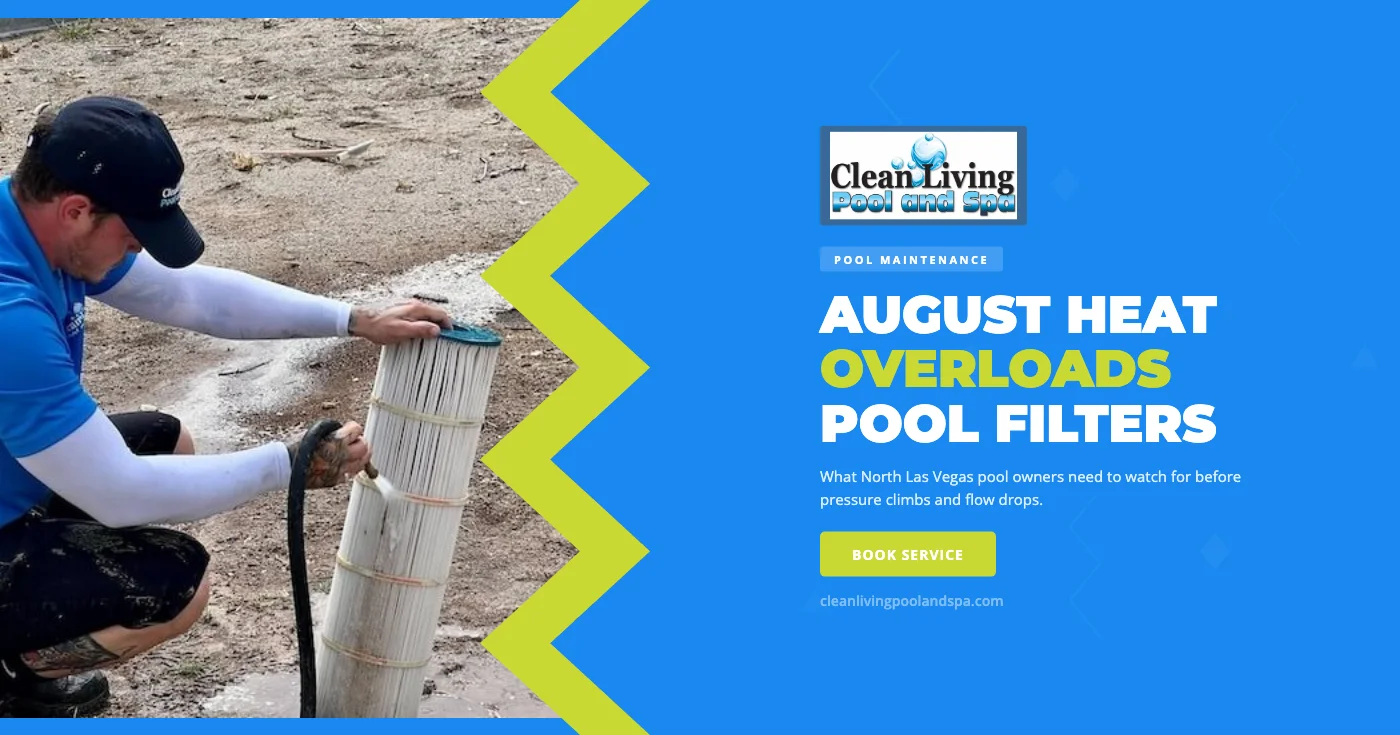
By the second week of August, the equipment pad tells the story better than the pool does. A filter that ran a clean 10 psi in early June is holding at 19 or 20. Return jets barely stir the surface. The heater throws a low-flow code. And the water — chemistry balanced, chlorine on target — still looks a shade off. August is when North Las Vegas pools stop forgiving small maintenance gaps. Peak-summer heat, an inch of daily evaporation, and the highest sunscreen and body-oil load of the year all land on the filter at once. At Clean Living Pool and Spa, we run Pool Maintenance Services across North Las Vegas, and pool filter cleaning north las vegas calls climb every August for the same reason. This guide covers why August is the toughest month for a filter here, the warning signs to catch early, cleaning cadence by filter type, which system handles desert dust best, and when a professional service call pays for itself.
Why August Heat Makes North Las Vegas Pool Filters Work Harder
August in North Las Vegas averages a 96°F high and roughly 22 percent relative humidity, and afternoons push the pad past 105°F. That combination stacks four different loads on the filter at once, and none of them ease up until September.
The first load is evaporation. Low humidity and constant heat pull water out of the pool at close to an inch per day. Every top-off adds fresh Colorado River water — hard, high-alkalinity, rich in calcium. As the pool concentrates through the month, calcium hardness climbs and the filter starts trapping precipitated minerals alongside everything else. The second load is sunscreen and body oil. August is peak swim season here — kids in the pool every afternoon, weekend gatherings — and a cartridge that never sees oil in April is being asked to catch spray sunscreen and skin oils on a daily cycle. That film coats pleats and blocks flow even when the physical debris is minimal.
The third load is thermal stress. Equipment-pad surface temperatures on a sunny August afternoon commonly reach 130°F to 140°F. Cartridge pleats fatigue faster at those temperatures, end caps warp, O-rings soften, and pump shaft seals age visibly across a single summer. The fourth load is chemistry drift — chlorine burns off two to three times faster in August sun than in April, so more organic material survives long enough to end up in the filter instead of oxidizing in the water. All four pressures compound. A cleaning cadence that worked in May is not enough by the second week of August.
Warning Signs Your Pool Filter Is Getting Clogged
Filters almost never fail overnight. They send signals for two to three weeks before flow collapses, and catching those signals is the difference between a routine cleaning and a full remediation with equipment damage.
- Filter pressure 8 to 10 psi above the clean baseline. Pentair and Hayward both tie their cleaning trigger to the same 8–10 psi rise over baseline (Cleaning and Maintaining Your Pool Filters, Pentair). Once the gauge crosses that line, sanitation, heating, and circulation all begin to suffer.
- Soft return jets. A healthy pool pushes water hard enough to stir the surface several feet out from the wall. When the return barely moves the water, the filter is throttling the pump.
- Hazy water that will not polish out. Chlorine, pH, and alkalinity can read perfectly and the pool still looks dull. A loaded filter cannot capture the fine mineral haze August evaporation creates.
- Heater or salt cell low-flow codes. An LF or FLO code in mid-August is almost always a filter complaint, not a heater or cell problem.
- Pump cavitation or new noise. A high-pitched whine, rattling, or intermittent surging is the pump pulling against a restricted filter. In 110°F pad heat, that stress shortens shaft seal and bearing life quickly.
- Longer run times without cleaner water. If the pump has to run extra hours just to keep the pool from clouding, the filter is the bottleneck.
Any single signal is a yellow flag. Two or more at once means the filter is past due and the surrounding equipment is paying the tax on it.
How Often Should North Las Vegas Homeowners Clean Their Pool Filter?
Spring cadences do not survive August. From late July through mid-September, cleaning intervals compress across every filter type, and the pressure gauge — not the calendar — has the final word. The CDC recommends operating filtration and recirculation systems on the manufacturer's schedule and adjusting based on load (Operating and Managing Public Pools, CDC), and desert load is well above the manufacturer's baseline assumptions.
- Cartridge filters: full chemical soak every four to six weeks through August — sooner if the gauge climbs faster after a dust event or a busy pool weekend. A hose rinse is not a cleaning; oil and mineral scale require a real soak.
- DE filters: backwash and recharge every three to four weeks through August, with a full tear-down and grid inspection at least once each summer.
- Sand filters: backwash every two to three weeks through August — the fine mineral silt August evaporation deposits is exactly what sand struggles with.
Three habits pay off through August. Skim and brush within twelve hours of any dust surge so the filter is not asked to catch particulate that could have been lifted out first. Test chemistry weekly — chlorine loss doubles in peak heat and unstable pH accelerates scale on the filter media. And log the pressure every visit against the clean baseline so a trend is visible early. North las vegas pool filter service routes show the same pattern every year: the pools that stay clear through August are the ones where the gauge got logged in July.
Cartridge vs. Sand vs. DE Filters: Which Handles Desert Dust Best?
The three common residential filter types behave very differently in Mojave conditions, and the right pick depends on the yard's dust exposure, the pool's run-time load, and how much backwash water the homeowner is willing to send down the drain.
Cartridge filters are the default new install across most of North Las Vegas. They filter down to roughly 10 to 20 microns, require no backwashing (a real advantage under southern Nevada water conservation rules), and a properly-sized quad-cartridge tank absorbs normal desert loads for four to six weeks between cleanings. National guidance says three to five seasons for cartridge life; in the Las Vegas valley we typically see two to three. Pool filter maintenance las vegas homeowners rely on has to include a chemical soak on a regular cadence — a hose rinse alone is not enough.
Diatomaceous earth (DE) filters deliver the finest filtration of any residential system, down to roughly 3 to 5 microns. They earn their place on pools downwind of construction, on heavily-landscaped lots that collect a lot of organic drift, or where the owner wants the clearest water year-round. The trade-off is more upkeep and more backwash water — grids need a fresh DE charge after every backwash, and torn or folded grids quietly bleed powder back into the pool for weeks if no one is watching.
Sand filters filter down to 20 to 40 microns and are the lowest-maintenance at the pad, but also the least suited to fine windblown silt. Fresh media can pass that particulate right back into the water, and sand demands backwash water our region is asked to conserve. For most North Las Vegas homeowners, our default recommendation is a properly-sized quad cartridge on a real cleaning schedule.
What Happens When You Skip Pool Filter Maintenance
A pool filter clogged las vegas summer conditions turn from a nuisance into an equipment problem faster than most owners expect. When the filter runs 15 psi above baseline for weeks, the failures cascade through the rest of the pad.
The pump goes first. Restricted flow spikes motor temperature at an already-hot pad and burns through shaft seals and bearings. A pump that should last eight to ten seasons in North Las Vegas often does not finish four when it is running against a permanently loaded filter. The heater is next — the heat exchanger can crack when flow drops below manufacturer minimums, and cracked exchangers are a replacement, not a repair. Salt cells suffer the same damage: plates scale over rapidly when water is not moving through them at rated flow.
Then the water itself gives up. Chlorine cannot maintain a residual against the organic load a saturated filter recirculates. Algae takes hold — first a green tint, then slick walls, then a full bloom that a shock treatment alone will not solve. The bill for a skipped filter cleaning almost always ends up higher than the maintenance would have cost, and the swim days lost to a green pool in August cannot be recovered.
When to Call a Professional Pool Filter Service in North Las Vegas
A homeowner can rinse cartridges and backwash a sand or DE tank between visits — that is genuinely useful. But a professional deep service catches things a rinse cannot. When the pressure gauge does not drop back to baseline after a hose cleaning, when the pump is making a new noise, when the water hazes despite balanced chemistry, or when a heater or cell code has appeared, a las vegas pool filter cleaning service call is the shorter path.
Our routine on a professional visit covers the whole system. The tank is depressurized and opened, cartridges pulled and inspected pleat by pleat for burn-through, calcium scale, and structural fatigue; DE grids come out of the manifold for a full visual on the fabric. Elements then get a chemical soak — a cleaner for mineral scale and a separate treatment for oils and sunscreen — long enough to release what a rinse cannot. The O-ring is lubricated, gaskets replaced when they show heat damage, the pump is primed, and the new clean pressure is recorded on the equipment card as the baseline every future visit gets measured against.
Clean Living Pool and Spa has run pool filter cleaning north las vegas routes since 2012, built around the same idea: catch the small problem in week one so August does not become a September equipment failure. If your gauge is climbing this month, reach out — we will pull the filter, inspect the media, and set you a clean baseline for the rest of the season.
Frequently Asked Questions
How often should I clean my pool filter in North Las Vegas during August? For a cartridge filter through peak summer, plan on a full chemical soak every four to six weeks — sooner if the gauge climbs faster after a dust event or a heavy-use weekend. Sand filters need a backwash every two to three weeks, DE filters every three to four. The pressure gauge is the final word: 8 to 10 psi above the clean baseline is the trigger regardless of the calendar.
Why does my North Las Vegas pool filter keep clogging even after I hose it off? A hose rinse only lifts loose surface debris. It does not touch the sunscreen film, body oil, or calcium scale that August peak swim season and desert evaporation pack into cartridge pleats and DE grids. Those require a chemical soak — a mineral cleaner and a separate oil treatment — to release. If the pressure sits above baseline after a rinse, the filter needs a full deep service, not another rinse.
Should I upgrade from a cartridge to a DE filter for cleaner water in the desert? For most North Las Vegas pools, a properly-sized quad cartridge on a real cleaning cadence delivers plenty of clarity without the extra maintenance and backwash water DE demands. DE upgrades pay off on pools downwind of construction or on heavily-landscaped lots that catch a lot of organic drift. We are glad to walk your pad and recommend the best fit.