
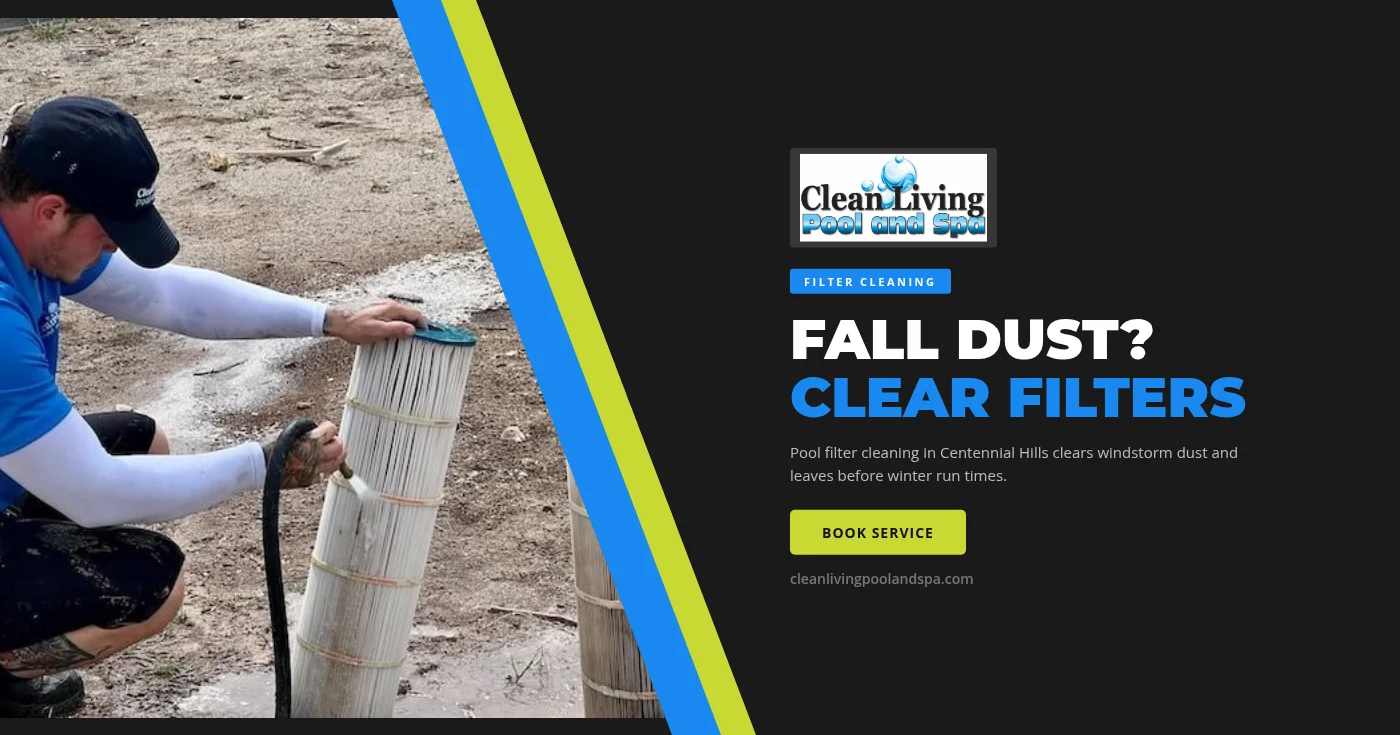
A fall cold front blows through, the wind roars out of the northwest for an afternoon, and by morning your pool looks mostly fine from the patio. Inside the equipment, though, the filter is quietly loading up with fine desert dust and shredded leaves. That’s why pool filter cleaning in Centennial Hills matters so much this time of year. A clogged filter drives pressure up, cuts circulation and dulls the water right before you dial back your pump for winter.
Centennial Hills sits on the higher northwest edge of the Las Vegas Valley, where fall fronts often push strong gusts straight across backyards. Add ash, Chinese pistache and sycamore trees dropping leaves in November, and your skimmer and filter take a beating even though nobody is swimming.
Here at Clean Living, we’ve cared for pools across the valley since 2012, and we see the same pattern every fall. Below, we’ll cover why wind hits filters so hard, the warning signs to watch for, and how dust affects cartridge, DE and sand filters. We’ll also explain what a professional cleaning includes and how to keep your filter clear until spring.
Why Fall Winds in Centennial Hills Hit Pool Filters Hard
Fall in the valley arrives with a series of cold fronts. The gusty winds around them lift loose soil from open lots, washes and construction sites and carry it for miles. Neighborhoods in the northwest, at roughly 2,700 to 3,000 feet, often feel those gusts first. The National Weather Service office in Las Vegas issues wind advisories during these events, and each one is a good reminder to check your pool equipment afterward.
Wind-blown dust isn’t like summer sand or grass clippings. Much of it is extremely fine, so it hangs in the water until the pump pulls it into the filter. Leaves blow in at the same time, sink and break down into smaller fragments. Your skimmer catches the big pieces, but the fine material packs tightly into the filter media and restricts flow. One windy day can load a filter more than several calm weeks combined.
And because most pools are closed for swimming by November, many homeowners don’t look closely until something is clearly wrong. By then, the filter may have been struggling for weeks.
Warning Signs: Rising Pressure, Weak Return Flow and Cloudy Water After a Windstorm
The pressure gauge on your filter is your best early warning. After a cleaning, note the reading with the pump running; that’s your clean baseline. Many manufacturers recommend cleaning when the gauge climbs about 8–10 psi above that number, though the exact figure varies by model, so check your owner’s manual.
After a windstorm, watch for:
- High pool filter pressure: a jump of several psi within a day or two of a dust event usually means fine particles are packed into the media.
- Weak return flow: jets that used to ripple the surface now barely move it.
- Cloudy or dull water: dust the filter can no longer trap keeps circulating.
- Chlorine disappearing faster: leaves and organic debris consume sanitizer, even in cooler water.
- Pump noise or strain: a pump pushing against a restricted filter can run louder and hotter.
If you’re wondering why your pool filter pressure is high in fall, a recent windstorm is the usual suspect. Still, a partly closed valve or a failing gauge can produce similar readings, which is why we look at the whole system rather than the gauge alone.
How Fine Desert Dust and Fall Leaf Debris Clog Cartridge, DE and Sand Filters
Every filter type handles dust a little differently. Industry figures vary by source, so treat the particle sizes below as approximate.
Cartridge Filters
Cartridges trap particles down to roughly 10–20 microns in their pleated fabric. Fine dust coats every pleat, and decomposing leaf matter can bind it in place. Our hard valley water also leaves calcium scale over time, so a cartridge loaded with dust and scale may not return to its original pressure after a quick rinse. Pool cartridge filter cleaning after a windy stretch often means a thorough pleat-by-pleat rinse and, periodically, a degreasing or soak following the manufacturer’s directions.
DE Filters
Diatomaceous earth filters capture the finest particles, often around 3–5 microns. That makes them excellent at clearing dust, but the DE coating on the grids fills quickly when a lot of fine material arrives at once. Backwashing helps, but DE filter grid cleaning, which means opening the tank and washing each grid, is typically recommended at least once a year. Fall is a smart time to do it.
Sand Filters
Sand filters catch larger particles, roughly 20–40 microns, so some of the finest dust can slip through and leave water hazy. Backwashing clears much of what they hold, but sand gradually clumps and channels and generally needs replacing every few years.
What a Professional Pool Filter Cleaning Includes
Hosing off a cartridge in the driveway helps, but a complete cleaning goes further. When our technicians clean a filter, the visit typically includes:
- Shutting off power and releasing pressure before opening the filter.
- Recording the starting pressure so we can measure the improvement.
- Removing cartridges or DE grids, or backwashing a sand filter, and cleaning the media thoroughly.
- Inspecting pleats, end caps, grids, manifolds and O-rings for tears, cracks or wear.
- Lubricating O-rings, reassembling the tank and bleeding trapped air.
- Recharging DE filters with the correct amount of fresh powder.
- Restarting the system and recording the new clean baseline.
- Testing water chemistry, since dust and leaves can shift pH and sanitizer levels.
Backwash water and spent DE also need to go to the right place. Local rules generally direct pool drain water to the sewer cleanout rather than the street or storm drain, but requirements can change, so we follow current guidance from the Las Vegas Valley Water District.
If we find a torn cartridge, a cracked grid or a pump that’s been straining, we’ll show you what we see. When a fix is needed, our pool repair team can take care of it, so there’s no guesswork on your end.
Why a Clean Filter Matters Before You Shorten Winter Pump Run Times
As water cools, most valley pool owners cut back pump hours. Many local pros run pumps roughly 4 to 6 hours a day in winter, and longer during freeze warnings so water keeps moving through the equipment. That’s a rule of thumb rather than an official standard, and your pool’s size and equipment matter.
Here’s the catch: fewer hours means less filtering each day. If your filter is already half-clogged with fall dust, those shorter cycles move even less water, and the pool can slide into cloudiness or algae that’s harder to correct in January. A restricted filter also makes your pump work harder for every hour it runs, which can mean higher energy use and extra wear on the motor.
Cleaning the filter before you change the timer is the heart of good pool filter maintenance in fall. It resets your baseline so reduced run times can actually do their job. It’s also a natural moment to have us check timers, valves and freeze protection as part of ongoing pool maintenance.
Keeping Filters Clear Between Cleanings: Skimmer Baskets, Pump Baskets and Weekly Service
The less debris that reaches your filter, the longer it stays clean. A few habits make a real difference during windy season:
- Empty skimmer baskets after every wind event. A full basket lets leaves slip into the line and starves the pump of flow.
- Check the pump basket. Leaf fragments collect here and restrict flow before they reach the filter.
- Brush and vacuum promptly. Dust settled on the floor eventually gets stirred back into circulation.
- Glance at the gauge. A quick look after each storm tells you when pressure is climbing.
- Trim overhanging branches. Fewer leaves in the water means less material breaking down in your filter.
Of course, most people would rather not run outside after every gust. That’s where dependable Centennial Hills pool service helps. With our weekly pool cleaning, we empty skimmer and pump baskets, vacuum, test and balance chemistry and keep an eye on filter pressure, so we can flag a filter that needs attention early. Here at Clean Living, that steady routine is what keeps pools clear through the windiest months.
Frequently Asked Questions About Pool Filter Cleaning After Fall Windstorms in Centennial Hills
How often should I clean my pool filter after a dust storm?
There’s no fixed calendar; the gauge decides. If pressure rises about 8–10 psi above your clean baseline after a storm, it’s time. During a windy fall, that can mean an extra cleaning or two beyond your usual routine.
Why is my pool cloudy after a windstorm in Centennial Hills?
Fine dust can be small enough to pass through some filters or to overwhelm one that’s already loaded. Cloudiness usually clears once the filter is cleaned, chemistry is balanced and the pump has time to circulate the water.
Can I just backwash instead of doing a full cleaning?
Backwashing helps sand and DE filters, but it doesn’t remove everything. DE grids still need a full teardown periodically, and cartridge filters can’t be backwashed at all. Backwashing too often also wastes water.
When should a cartridge be replaced?
Many cartridges last somewhere around one to three years, depending on use and care. If the pleats are frayed, flattened or hardened, or pressure stays high right after a cleaning, replacement is usually the better choice.
Schedule Pool Filter Cleaning in Centennial Hills With Clean Living
Fall winds will keep sweeping across the northwest valley, but they don’t have to leave you with a strained pump and cloudy water heading into winter. Timely pool filter cleaning in Centennial Hills clears out dust and leaf debris, restores healthy flow and gives shorter winter run times a fair chance to keep your water clear.
John and Julie Butler founded Clean Living in 2012, and we’ve served pool owners in Las Vegas, North Las Vegas, Summerlin and the northwest valley ever since. If your gauge is climbing or you’d like a professional look at your equipment before winter, contact us to schedule your filter cleaning. We’ll get your filter, and your pool, ready for the season ahead.
Who Can Clean My Pool Filter and Keep My Pool Clear All Winter?
We’re Clean Living, a family-run pool service founded by John and Julie Butler in 2012. We take care of pools across Las Vegas, North Las Vegas, Summerlin and Centennial Hills, and fall windstorm season is when our customers lean on us most. Whether your filter pressure just spiked after a dust event or you want everything in order before cutting back pump hours, we’re ready to help.
Here’s how we can support your pool this season:
- Filter Cleaning: thorough cleaning of cartridge, DE and sand filters, with a fresh pressure baseline recorded after every visit.
- Weekly Pool Service: skimmer and pump basket emptying, vacuuming, tile cleaning and water analysis so debris never piles up.
- Pool Maintenance: equipment inspections, chemical treatment and seasonal adjustments to keep your system running smoothly.
- Pool Repair Services: pump repair and replacement, motor repair and replacement, and pool vacuum repair and installation when wear turns up.
- Pool Consulting: practical guidance on equipment, run times and care routines that suit your pool.
- Property Management Pool Service: dependable, routine care for rental and managed properties.
We know a clean filter is just one part of a healthy pool, so we look at the whole system every time we visit. If you’d like steady, attentive care through the windy months and beyond, reach out to our team and we’ll find a schedule that works for you.