
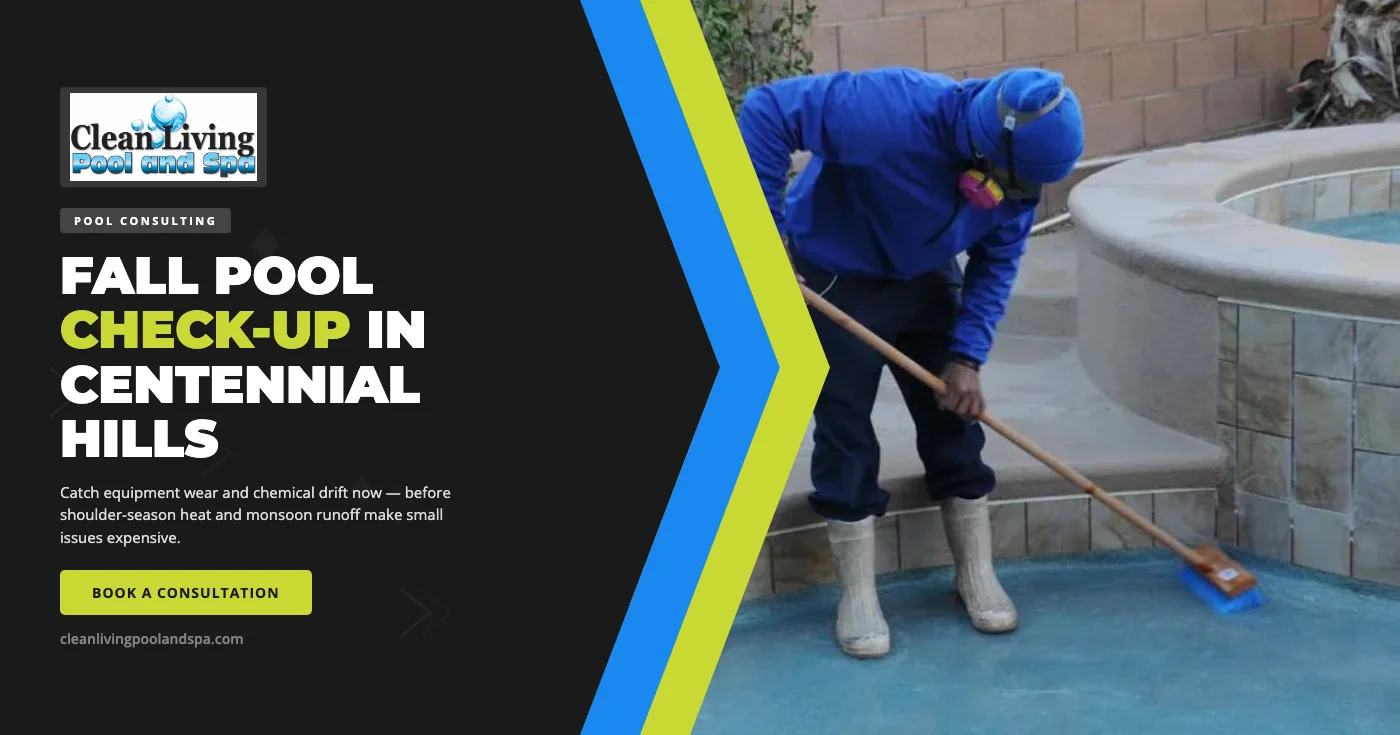
By the time September lands in Centennial Hills, a pool tells a different story than the calendar does. Daytime highs still push 98°F, evening temperatures dip into the low 70s, and water that stayed clear all summer can haze overnight. Pump shaft seals show the wear of four months at 140°F pad temperatures. Cartridge filters carry a summer's worth of calcium scale and body oil. The chlorine schedule that held in July stops holding by mid-September. Fall is when small maintenance gaps become equipment failures — and it's the most valuable time of the year to book pool consulting centennial hills nv homeowners can actually act on before winter creeps in. At Clean Living Pool and Spa, we run Pool Consulting Services across Centennial Hills and the Las Vegas valley. This guide covers what a professional consultation actually looks at, the warning signs to catch now, and why waiting until spring almost always costs more than acting in September.
Why Centennial Hills Pools Face Unique Challenges as Summer Ends
Centennial Hills sits at roughly 2,900 feet along the northwestern edge of the Las Vegas valley, where UV intensity, hard tap water, and the last dust surges of monsoon season all compound in September. The Mojave doesn't quietly transition into fall — daytime pad temperatures still hit 105°F to 110°F through the first two weeks of the month, evaporation continues at nearly an inch per day, and every top-off adds fresh Colorado River water rich in calcium and alkalinity.
That combination sets up a chemistry pattern most homeowners never see coming. Chlorine that burned off in six hours in July begins holding into the next day as UV weakens, and pH creeps steadily upward as CO2 gasses out of warmer water. Calcium concentrates faster than at any other point in the year because evaporation stays high while make-up water keeps pouring in. The pump and filter are still running at peak summer load, but swimmer demand is falling, so problems that hid behind heavy circulation start to surface.
The other pressure is thermal cycling. When daytime pad temperatures are 105°F and pre-dawn drops into the low 70s, that 30-degree swing works cartridge end caps, pump housings, and heater exchanger metal every single day. Equipment that survived June through August because it was heat-soaked constantly begins to show fatigue in September because it's expanding and contracting through a wider range. A pool consultant las vegas homeowners trust is looking specifically for the wear that shows up now — not the wear that shows up in August.
What a Professional Pool Consultation Actually Covers
A real pool consultation isn't a quick water test at the pool store — it's a walk of the whole system by a technician who's watched hundreds of Centennial Hills pools go through the summer-to-fall transition. We start at the equipment pad, because that's where the season's damage shows up first, and we work outward from there.
On the pad, we depressurize and open the filter tank to inspect the media directly. Cartridge pleats get eyeballed for burn-through, calcium scale, and structural fatigue. DE grids come out of the manifold for a full visual on the fabric. The pump volute and impeller get inspected, shaft seal weep is measured, and the clean pressure gets recorded as the baseline every future service call gets checked against. The heater comes next — burner tray, exchanger, ignition, and the flow switch that keeps the whole appliance from cracking during a low-flow event. Valves and actuators get cycled, unions checked for weep, and the timer or automation panel walked through for accuracy.
The water side is a full 8-point panel: free chlorine, total chlorine, pH, total alkalinity, calcium hardness, cyanuric acid, salt (on salt pools), and phosphates. We finish with a slow walk of the pool itself — tile line, coping, plaster or pebble, ladders and rails, deep-end main drain, skimmer weirs. What you leave with is a written baseline card and a prioritized action list of what needs attention now, what can wait through winter, and what belongs on a spring watch list. That's what professional pool consultation nevada owners are actually paying for.
Signs Your Pool Equipment Needs Attention Before Fall
Pool equipment rarely fails without warning — the signals show up two to four weeks before something breaks, and reading them early is the difference between a $200 service call and a $2,800 replacement. Watch for any of the following through late September and October.
- Filter pressure 8 to 10 psi above the clean baseline. Pentair and Hayward both tie the deep-cleaning trigger to this range (Cleaning and Maintaining Your Pool Filters, Pentair). Above baseline, sanitation, heating, and circulation all suffer at once.
- New pump noise. A whine, rattling, or intermittent surge is the pump pulling against restriction or a shaft seal weep letting air into the volute. At the pad temperatures a September afternoon still delivers, that stress compounds fast.
- Chlorine that won't hold overnight. As UV weakens, a healthy pool should stretch its residual — not lose it faster. Overnight drop past 1.5 ppm points at high organic load, cyanuric drift, or a saturated filter cycling debris back into the water.
- Heater or salt cell low-flow codes. An LF, FLO, or LO code in September is almost always a filter or valve complaint, not a heater problem. Ignoring it risks a cracked exchanger.
- Hazy water that will not polish out. Balanced chemistry with dull water usually means the filter is loaded, calcium is precipitating, or a phosphate load is feeding a slow algae takeoff.
- Longer pump run times without cleaner water. If the timer is up an extra two or three hours a day just to hold clarity, something upstream is choking flow.
Two or more of these together mean the consultation shouldn't wait past next week.
How Desert Heat Affects Your Pool's Water Chemistry Over the Summer
Four months of Mojave summer leaves fingerprints on pool water that only a full panel picks up. Chlorine consumption doubles in July and August because UV breaks the molecule apart in hours instead of days, and most homeowners compensate by adding tabs — which quietly pushes cyanuric acid past 80 or 90 ppm by early September. Above 100 ppm, chlorine efficacy drops sharply, and no amount of shocking recovers it without a partial drain and refill.
Evaporation is the other silent chemistry lever. Every gallon that leaves as vapor leaves calcium and dissolved solids behind, and every gallon of make-up water arrives with more of both. Colorado River source water in the Las Vegas valley runs 250 to 300 ppm calcium hardness before it hits the pool — after a summer of evaporation, most Centennial Hills pools measure 500 to 700 ppm, well past the 200 to 400 ppm target range for plaster or pebble finishes.
pH creeps up as CO2 gasses out of warm water and as the sun bleaches organic acids, and a pH that sits above 7.8 for weeks pushes calcium out of solution onto tile, plaster, and the salt cell. The CDC recommends operating filtration and recirculation systems on the manufacturer's schedule and adjusting based on load (Operating and Managing Public Pools, CDC). In Centennial Hills, that adjustment isn't optional — it's the whole difference between a clean fall and a spring startup that begins with a drain, an acid wash, and a stack of replacement parts.
The Cost of Skipping a Fall Pool Consultation
The math on a skipped consultation always looks reasonable in September and painful by March. A $180 to $250 consultation catches the shaft seal weep before the motor windings short, the exchanger scale before the heater cracks, and the cyanuric overload before it locks up the entire sanitizer system. When those problems get to spring untouched, the price tag changes character.
A pump that failed against a clogged filter through six weeks of unattended running is usually a full motor or full pump replacement — $600 to $1,400 installed, not a $180 seal change. A heater exchanger that cracked because a flow switch never got tested is a $1,800 to $2,900 repair, and often a full heater swap because the replacement exchanger costs almost the same as a new unit. Cyanuric that's climbed past 120 ppm requires a partial drain and refill — in the Las Vegas valley, SNWA restrictions make that a real conversation.
Then there's the finish. Plaster that spent a winter under 700 ppm calcium hardness with a pH stuck at 8.2 shows up in April with scale bands on the tile line and etching in the shallow end. That kind of surface damage doesn't polish out. Pool care advice centennial hills homeowners consistently value most is the same: catch it in fall while it's a service call, before it becomes a resurface.
What to Expect When You Schedule Pool Consulting Services
Booking pool service centennial hills las vegas owners can trust looks the same across most reputable operations, and the first appointment is what sets the tone for everything after it. When we come out for a consultation, we plan on 60 to 90 minutes on-site — enough time to actually see the whole system, not just check boxes.
The visit starts with a short conversation about what you've noticed — the noise you've been hearing, the pressure that seems higher, the chlorine that's been harder to hold. From there we walk the pad together so you can see what we see. The filter comes apart. The pump gets inspected. Chemistry gets pulled from mid-depth and run through a full panel on-site or at the truck. The pool itself gets a slow visual — tile, coping, plaster, hardware, and any recent additions like a heater retrofit or auto-cover.
You leave with a printed baseline card that captures every reading, a photo record of any wear or scale found, and a prioritized recommendation list broken into "act now," "watch through winter," and "budget for spring." Nothing on the list is a sales pitch — it's what a technician who's been through hundreds of Centennial Hills summer-to-fall transitions is telling you the pool needs. Clean Living Pool and Spa has been running these consultations across Las Vegas, North Las Vegas, Summerlin, and Centennial Hills since 2012, and pairs cleanly with our ongoing Pool Maintenance Las Vegas program if a weekly service becomes the next step.
Frequently Asked Questions
When should I schedule a pool consultation in Las Vegas? The two highest-value windows are early-to-mid September and early March. September catches the wear a Mojave summer just put on the equipment while the pool is still running warm enough to show flow, sound, and chemistry problems clearly. March catches whatever drifted through winter before demand ramps back up in April. If you're only going to book once a year, September delivers more actionable findings.
What does a pool consultation actually include? A full consultation covers the equipment pad (filter tear-down and inspection, pump review, heater walkthrough, valves and automation), an 8-point water chemistry panel run on-site, and a structural walk of the pool itself covering tile, coping, plaster or pebble, and hardware. You leave with a written baseline card and a prioritized action list — what needs immediate attention, what can wait through winter, and what to budget for spring. Expect 60 to 90 minutes on-site for a residential pool.
How is a fall consultation different from a spring pool opening? Spring openings focus on getting the pool swim-ready after winter — chemistry balance, filter cleaning, cover removal, equipment startup. A fall consultation is diagnostic instead of restorative. We're looking at the wear a full summer put on the system while everything is still under peak load, so we can see the pump running, hear the motor, feel the return jets, and read chemistry the way it actually behaved through July and August. Fall problems caught in September are almost always cheaper to fix than the same problems discovered when the pool won't start in April.