
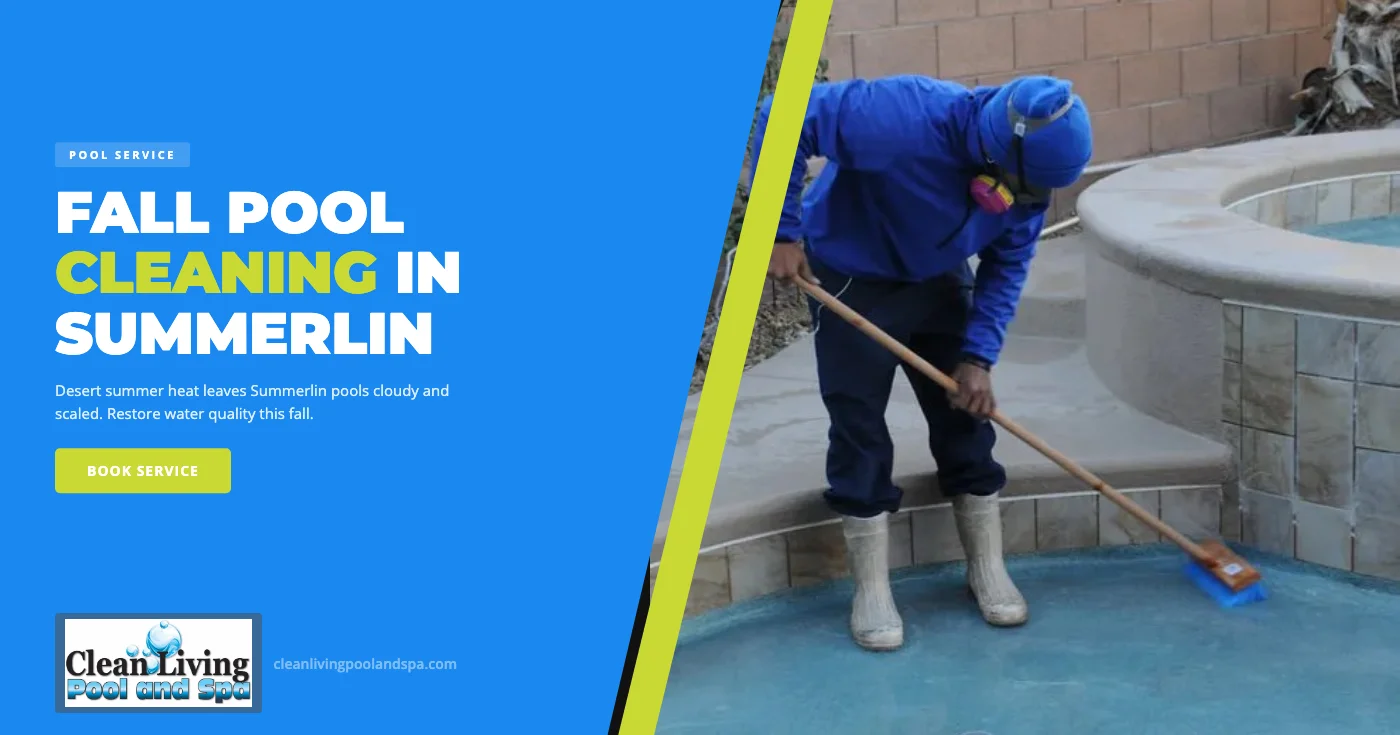
By late September in Summerlin, the water that looked crystal in June has quietly changed underneath — calcium has concentrated at the waterline, cyanuric acid has climbed past effective range from three months of chlorine tabs, and the filter is carrying a summer of body oil, monsoon dust, and desert grit that no cartridge can flush with a garden hose. That combination — plus 30-degree daily temperature swings that start rolling through the valley in late September — is why the pool cleaning summerlin nv homeowners think they can push to spring quietly turns into a $1,200 remediation call in April. At Clean Living Pool and Spa, we run Weekly Pool Service across Summerlin, Las Vegas, North Las Vegas, and Centennial Hills, and every year the fall pool cleaning las vegas homeowners schedule between mid-September and mid-October ends up being the highest-value visit of the season. This guide walks through what desert summer actually does to a pool, the exact signs it needs a professional cleaning before fall settles in, and what a real fall reset looks like from the pad to the plaster.
Why Summerlin Pools Need Special Attention After Desert Summer Heat
Summerlin's climate sits at the intersection of three variables no other pool market has to manage simultaneously. Municipal water arrives at 200 to 400 parts per million calcium hardness — three to five times the mineral load a Midwest or coastal pool sees — and every ounce of evaporation concentrates those minerals further. In the high desert, an uncovered pool loses roughly a quarter-inch to half-inch of water per day between June and September, which means the pool refilled to fresh in May has effectively been re-mineralized twice by the end of summer. That's before monsoon season adds a layer of ultra-fine silica dust that clings to plaster, tile grout, and cartridge pleats through July and August.
The second variable is ultraviolet exposure. UV in the valley runs 20% to 30% above sea-level averages through the summer window, which accelerates chlorine loss and pushes homeowners toward heavier stabilizer use. By September, cyanuric acid readings above 90 parts per million are common — and once cyanuric climbs past that threshold, chlorine's ability to kill algae and bacteria drops sharply. The CDC recommends operating pool filtration and disinfection on manufacturer-specified schedules and adjusting to bather load and environmental conditions (Operating and Managing Public Pools and Hot Tubs, CDC), and that guidance holds for residential pools too — a system that has fought a valley summer needs a reset before the load shifts.
The third variable is the fall temperature swing itself. From mid-September through October, Summerlin daytime highs still push 90°F to 100°F while pre-dawn lows drop into the low 60s. That 30- to 35-degree daily swing works pump housings, filter clamps, tile grout, and heater exchanger metal every 24 hours. Water that was thermally stable in July starts stratifying, chlorine that burned off in six hours starts holding overnight, pH creeps upward as CO2 gasses out of cooler water, and any weakness carried through summer starts to surface. Pool service summerlin nv work in September is not opening a pool — it's decommissioning a summer.
Signs Your Pool Needs a Professional Cleaning Before Fall
The signals almost always show up two to four weeks before the water shifts visibly. Homeowners who catch them early move from a $200 to $300 professional cleaning into a routine seasonal reset; homeowners who wait until the pool actually looks tired usually spend two to three times as much dropping the water back into range. Through late September in Summerlin, watch for any of the following:
- Waterline calcium ring you can feel with a fingernail. A slight roughness where the surface meets the tile is early scale — still soft enough for a professional brush and light acid protocol, but hardening every week the calcium concentration climbs.
- Cloudy water that clears slowly after a shock. If a full chlorine shock does not return water to sparkle inside 24 hours, the filter is carrying more than it can flush, or cyanuric has climbed past the point where chlorine can do its job.
- Filter pressure 8 to 10 psi above the clean baseline. Pentair and Hayward both tie the deep-cleaning trigger to that range (Cleaning and Maintaining Your Pool Filters, Pentair). Above baseline, sanitation, heating, and circulation all suffer at once.
- Sunscreen slick that returns within a day of skimming. Body oils and lotion residue that survived summer will keep re-emerging until the water column is chemically reset — surface skimming alone does not touch it.
- Persistent green tinge in shaded corners. Early-stage algae in the parts of the pool that get less UV means the sanitizer is not reaching everywhere. It's a system signal, not just an algae signal.
- Chlorine that will not hold overnight. As UV weakens through September, a healthy pool should stretch its residual — not lose it faster. An overnight drop past 1.5 ppm points to high organic load, cyanuric drift, or filter media at end of life.
Two or more of these together usually means the pool needs a professional pass now — not next month. Waiting through October only makes the same problem harder to reset, because cooler water slows every reaction the chemistry needs.
What a Professional Pool Cleaning Service Includes
A professional pool cleaning after summer las vegas visit is different from routine weekly service. Weekly service maintains — vacuum, skim, brush, chemistry check, empty baskets. A fall reset undoes a summer of drift and gets the pool ready to hold clean through cool-water conditions. Our fall pool cleaning walks the whole system:
- Full water panel. Free and total chlorine, pH, total alkalinity, calcium hardness, cyanuric acid, phosphates, and TDS. Every subsequent step on the visit follows the numbers.
- Filter deep clean. Cartridges get pulled, hosed, and soaked in a filter degreaser to break down body oil and sunscreen residue that a water hose cannot flush. DE grids get inspected and recharged. Sand filters get inspected for channeling and backwashed on the correct rinse cycle.
- Waterline tile brush. Early-stage calcium comes off with a professional pumice or nylon-brush pass. Anything hardened past the softest layer gets flagged for a targeted bead-blast or acid protocol on a dedicated tile-cleaning visit.
- Full-length wall and floor brush. Every surface gets brushed, including behind the ladder, around the light niches, and along the shaded corners where algae first appears. The vacuum pass follows.
- Skimmer, pump basket, and pool sweep inspection. Baskets get pulled and cleaned, weirs get checked for a full seal, and any pool sweep or robotic cleaner gets a filter and drive-belt check.
- Balance chemistry to seasonal targets. Fall targets differ from summer targets — pH slightly lower to counter CO2 outgassing, alkalinity in the middle of range, cyanuric drawn down through partial water replacement when it has climbed past 90 ppm.
- Written work order. Everything found — hardened scale, aged cartridges, valve wear, chemistry outliers — goes on a work order with a prioritization for now, before winter, and spring.
The visit typically runs 60 to 90 minutes and ends with the pool measurably reset. Homeowners get the panel readings before and after, so the following week's weekly service walks in on a known baseline.
How to Clear Calcium Scale and Algae Buildup After Summer
Calcium scale and algae are the two visible summer legacies, and they respond to completely different protocols — mixing the two is where most DIY attempts go wrong. Scale is a mineral deposit, and it comes off mechanically or chemically depending on how deeply it's set. Soft, chalky scale still pumice-brushable comes off with a professional tile brush and the water column pulled to just below the ring. Hardened scale — the frosted, crystalline layer no brush touches — needs a targeted acid protocol, and once it has built up past a millimeter, most homeowners fare better with a professional bead-blast visit than an acid wash they have never run before. Acid on plaster is unforgiving; a missed rinse can etch the finish in ways that do not polish out.
Algae after summer usually falls into three types. Green algae is the most common — it responds to a chlorine shock (typically 10 to 30 ppm free chlorine for 12 to 24 hours), a full brush pass, and a filter that can move it out of the water column. Yellow (mustard) algae is more stubborn and needs a longer shock at higher concentration plus targeted algaecide chemistry — sunscreen residue and phosphate load feed it, so a chemistry reset comes first. Black algae, when it shows up, is the hardest: it embeds in plaster pores and always needs a targeted pumice-and-shock protocol layered over the affected spots. Every one of those responses assumes cyanuric acid is at or below effective range; above 90 ppm, no shock strength will kill algae until the water is partially drained and refreshed. That's why the panel test always runs first — the numbers dictate the sequence.
Equipment Checks That Should Not Wait Until Winter
Fall is the last window to catch equipment issues before cold water masks the symptoms. Once daytime highs drop into the 70s and the pump runs half its summer hours, a marginal capacitor, a weeping shaft seal, or a saturated filter can hide until April — and April is when the same problem becomes an emergency call. Our fall cleaning visit includes a full pass across the pad:
- Pump housing, motor, and shaft seal. A visible drip under the wet end, a new noise on startup, or a pump housing too hot to hold gets flagged. Any two together usually mean the diagnostic visit should not wait past a week.
- Filter media condition. Cartridges over three seasons old are typically at the point where a full soak no longer restores original flow. DE grids get inspected for tears and manifold cracks. Sand at year eight or older gets tested for channeling.
- Heater exchanger and burner tray. A cracked exchanger or a rust-scaled burner tray gets flagged. Heater ignition assemblies that have failed twice in a season go on the replace-before-winter list.
- Valves and actuators. Multiport gaskets, actuator arc rotation, and check valve seating each get cycled. A valve issue is often what a "weak circulation" complaint actually is.
- Timer, automation, and salt cell. Timers that drift, salt cells past three years of running hours, and automation controllers that lag setpoints all get checked and, where the panel is aging, noted for spring replacement.
An equipment issue caught in September usually writes a $180 to $250 work order. The same issue caught in April routinely doubles or triples that number, because pool traffic in April overloads every service window in the valley and parts availability tightens.
Scheduling Your Fall Pool Cleaning with Clean Living Pool and Spa
The productive window for a fall reset in Summerlin runs roughly mid-September through late October. Earlier than mid-September, summer heat is still driving daily chemistry drift and any deep clean will need touch-up work within a week. Later than late October, cooler water slows every chemical reaction the reset needs, and any equipment repair pushes into shorter service windows and longer parts lead times. We generally recommend scheduling the fall visit as a bolt-on to a client's regular weekly service — the technician who is already tracking the pool's baseline can see exactly what has shifted and where to focus.
Clean Living Pool and Spa has been running Pool Maintenance Las Vegas since 2012, and every fall visit ends with a documented baseline — water panel readings before and after, filter pressure at the clean baseline, and a prioritized work order for anything the pool will need through winter and into spring. Whether the pool is on our weekly route or you have handled maintenance yourself through summer, the fall reset is the highest-return single visit of the year. Every dollar spent in September saves two or three in April, and the pool that opens in April with a documented baseline holds clean through summer with less chemistry, less runtime, and less friction than any pool starting spring from an unknown state.
Frequently Asked Questions
When should I schedule a fall pool cleaning in Summerlin, NV? The most productive window runs from mid-September through late October, once daytime highs drop below 100°F but before water temperatures fall into the low 60s. That range gives the chemistry room to reset without fighting either extreme, and it's early enough that any equipment issues caught on the visit can be repaired before winter parts lead times tighten.
Can I do a fall pool cleaning myself, or should I hire a professional? Simple maintenance tasks — surface skimming, weekly chemistry checks, and basket emptying — are within reach for most owners. A fall reset is different: it typically involves a filter deep-clean, calcium and algae protocols that assume a full chemistry panel, and equipment inspection across the pad. Homeowners who try to handle the reset themselves often spend more in chemistry and correction visits than a single professional pool cleaning summerlin nv call would have cost.
How much does professional pool cleaning nevada homeowners can expect this fall? A fall pool cleaning generally runs $200 to $400 depending on pool size, chemistry state, and filter type. A pool held clean through summer with professional weekly service will fall on the lower end; a pool that drifted through summer with cyanuric climbing past 90 ppm and calcium scaling at the waterline typically requires a longer visit and correction chemistry, pushing toward the higher end. The written work order after the visit spells out exactly what the pool needed and what the follow-up plan looks like.